

The market for automated pentest tools splits into two camps that rarely get compared honestly: free, best-of-breed open-source utilities that each do one stage brilliantly, and commercial platforms that fold the whole workflow into one product. Both are legitimate. Which is right for you depends on whether you have the time to assemble and maintain a pipeline, or whether you would rather run one command and get a report.
This guide maps the 2026 landscape of automated pentest tools by the stage of the pentest they automate, names the strongest open-source option for each, and explains where an all-in-one pentest management platform earns its keep. It is the practical companion to our pillar on automated penetration testing.
What makes a good automated pentest tool
Before the list, the criteria that separate a useful automated pentest tool from a noisy one:
- Validation, not just detection. The best tools confirm exploitability instead of dumping a list of maybes.
- Coverage of a full stage. A tool should own its stage – discovery, scanning, or exploitation – rather than half of it.
- Scriptable + integrable. CLI-first, with output (JSON, SARIF) that feeds your own pipeline.
- Actively maintained detections. Templates and exploits that keep pace with new CVEs.
- Self-hostable. For sensitive engagements, the tool should run on infrastructure you control.
One criterion deserves emphasis because it is the most common disappointment: signal-to-noise. A tool that surfaces 10,000 findings has not helped you – it has only moved your triage problem downstream. The automated pentest tools worth running are the ones that validate and prioritize, so what lands on your desk is a short list of confirmed, reachable issues rather than an undifferentiated dump of maybes. Hold every option below to that standard, whether it is a single-stage open-source utility or a full platform: the question is never “how much can it find” but “how much of what it finds is real.”
The best automated pentest tools by stage (2026)
A complete automated pentest chains several tools. Here is the strongest open-source option at each stage – the building blocks of any DIY pipeline:
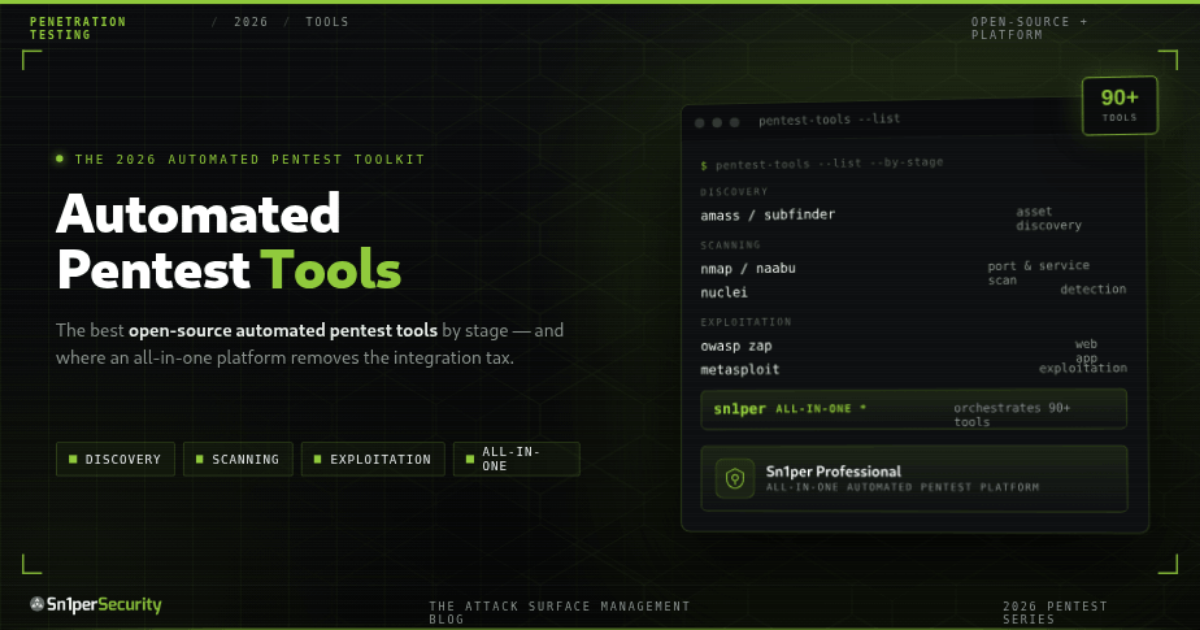
- Asset discovery: OWASP Amass and Subfinder map subdomains and infrastructure from public sources – certificate transparency logs, DNS, and passive datasets. Discovery is the foundation: everything downstream can only test what you found here, so weak discovery quietly caps the whole pipeline.
- Port & service scanning: Nmap remains the standard for confirming what is live and listening, with version detection and the NSE scripting engine. Naabu and httpx pair with it for fast, large-scale probing before the deeper Nmap pass.
- Vulnerability detection: Nuclei runs a large, community-maintained library of YAML templates against discovered assets at high speed, and new templates ship within days of major CVEs – which is what keeps automated detection current rather than stale.
- Web application testing: OWASP ZAP automates crawling and active scanning of web apps and APIs, with sqlmap and Wapiti covering specific classes such as SQL injection in greater depth.
- Exploitation: the Metasploit Framework automates validated exploitation of a vast catalogue of known vulnerabilities, turning a detection into proof that the issue is actually exploitable rather than theoretical.
Each is excellent. The catch is that you are the integration layer: you wire discovery output into scanning, scanning into detection, detection into exploitation, and reconcile it all into a report by hand – then keep that pipeline working as each tool changes. For a single operator with time, that is a legitimate path. At any scale, it becomes a maintenance burden.
Building a DIY automated pentest pipeline
If you go the open-source route, the tools chain in a predictable order – the output of each stage feeds the next. A minimal pipeline looks like this:
# 1. Discover subdomains, then probe for live HTTP services
amass enum -d acme.com -o subs.txt
httpx -l subs.txt -o live.txt

# 2. Fast port sweep + detailed service scan on what is live
naabu -l live.txt -o ports.txt
nmap -sV -iL live.txt -oA acme-nmap

# 3. Template-based vulnerability detection at scale
nuclei -l live.txt -severity high,critical -o nuclei.txt

# 4. Targeted, validated exploitation of confirmed candidates
msfconsole -q -x "use exploit/...; set RHOSTS ...; run; exit"
Beyond the headline tools, a real pipeline pulls in supporting utilities: Subfinder for extra discovery sources, httpx and Naabu for fast probing, Wapiti or sqlmap for specific web classes, and an aggregator like Faraday to collect the output. Every addition is another integration to wire and another project to keep current. The pipeline works – and for a single operator who enjoys the control, it is a perfectly good answer. The cost is simply that you own the glue: when Nuclei changes its output format or Amass ships a breaking release, fixing the pipeline is your problem, on your time.
DIY tool stack vs an all-in-one platform
This is the real decision behind the “automated pentest tools” search, and it is why “pentest management platform” is its own high-intent query. The trade-off:
| Approach | Strength | Cost | Best for |
|---|---|---|---|
| DIY open-source stack | Free, transparent, flexible | Your time: integration + maintenance | Single operators, learning, tight budgets |
| Point commercial scanners | Polished single-stage automation | Per-tool licensing, still siloed | Teams needing one specific capability |
| All-in-one automated pentest platform | Recon + scan + exploit + report in one workspace | One license, no pipeline to maintain | Teams that want coverage without glue code |
An all-in-one platform does not make the open-source tools obsolete – it orchestrates them. The value is removing the integration tax: one command instead of a pipeline, one workspace instead of a directory of text files, one report instead of manual reconciliation.
When to graduate from a tool stack to a platform
The DIY stack has a natural ceiling. These signals usually mean it is time to consolidate onto an all-in-one automated pentest platform:
- You spend more time maintaining the pipeline than testing with it. When glue code and tool upgrades eat your week, the tools are managing you.
- Asset count outgrew the spreadsheet. Past a few dozen targets, reconciling scattered tool outputs by hand stops scaling.
- You need to show someone the results. Auditors, clients, and management want one coherent report, not four raw text files.
- More than one person runs tests. Shared workspaces, run history, and a consistent methodology matter the moment a second operator joins.
- You need a schedule. Cron-ing five separate tools and merging their deltas is fragile; a platform schedules the whole workflow as a single job.
None of this makes the open-source tools wrong – a platform that orchestrates them gives you the same engines without the integration tax. The decision is simply where your time is best spent: assembling and babysitting tooling, or actually testing.
Where Sn1per fits
Sn1per is an all-in-one automated pentest platform that orchestrates 90+ of these underlying tools – Amass, Nmap, Nuclei, and many more – into a single self-hosted workspace, then layers 600+ exploits and 10,000+ detections on top for validation. It has been self-hosted by design since 2015 and is used by 500+ teams. Instead of assembling and maintaining the pipeline, you run one command:
# The DIY chain, run by hand:
amass enum -d acme.com -o assets.txt
nmap -sV -iL assets.txt -oA acme-nmap
nuclei -l assets.txt -severity high,critical
# ...then reconcile three output formats into a report manually.

# The same chain, orchestrated and validated by Sn1per, into one workspace:
sniper -t acme.com -m web -w acme
Because it persists findings to a workspace (with a JSON API for export), Sn1per also functions as the pentest management platform layer the DIY stack lacks – deduplicated, severity-ranked findings in one place rather than scattered across tool outputs.
- Sn1per Community Edition – free, source-available CLI; the all-in-one core.
- Sn1per Professional 2026 – adds the web UI, scheduled scans, exportable reports, and JSON API v1.0.
- Sn1per Enterprise – multi-operator pentest management at scale.
If you also test web applications interactively, the free SILENTCHAIN AI Community Edition adds AI-assisted analysis of HTTP traffic and supports a local Ollama runtime, so AI inference stays in your perimeter.
The role of AI in automated pentest tools (2026)
The biggest shift in automated pentest tooling in 2026 is AI moving from marketing slide to working component – triaging which detections are worth an exploit attempt, reasoning about multi-step chains, and cutting false positives so humans see a shorter, higher-quality queue. The honest caveat is that AI is an accelerant on top of solid automation, not a substitute for it: a tool that cannot reliably discover, scan, and validate will not be rescued by a language model bolted on the side. The other consideration is data residency – many AI-enabled tools ship your traffic and findings to a third-party model. A self-hosted approach (Sn1per for the pentest workflow, plus the local-Ollama option in SILENTCHAIN AI Community) keeps both the testing and the AI analysis inside your perimeter, which is decisive for regulated and sensitive engagements.
Are the best automated pentest tools free?
Largely, yes – the core engines are open source. Amass, Nmap, Nuclei, OWASP ZAP, sqlmap, and the Metasploit Framework are all free, and a capable operator can build a genuine automated pentest pipeline from them at zero license cost. Sn1per Community Edition is also free and source-available, and it orchestrates many of those same tools into one CLI, so you get the all-in-one workflow without paying for it. What you pay for, when you move to a paid tier, is not the scanning capability itself – it is everything around it that free tools leave to you: a managed web UI, scheduled and differential runs, deduplicated and severity-ranked findings, multi-operator workspaces, client-ready exportable reports, and an API. For learning, solo research, and tight budgets, the free stack is the right answer. For teams that need coverage, reporting, and scheduling without maintaining glue code, the paid layer pays for itself in reclaimed hours.
Getting started
Try the all-in-one path against a domain you own: install Sn1per Community Edition and run sniper -t yourdomain.com -m web, then compare the single-command experience to wiring Amass, Nmap, and Nuclei together yourself. Move to Sn1per Professional 2026 for scheduling and the management UI, or browse every edition on the shop page. The right tool is the one your team will actually run on a schedule, not the one with the longest feature list. To understand the methodology behind the tools, read the pillar, automated penetration testing.
Frequently asked questions
What are the best automated pentest tools?
The strongest open-source automated pentest tools by stage are OWASP Amass and Subfinder for discovery, Nmap for port and service scanning, Nuclei for vulnerability detection, OWASP ZAP for web application testing, and the Metasploit Framework for exploitation. All-in-one platforms like Sn1per orchestrate these underlying tools into a single automated workflow so you do not have to maintain the pipeline yourself.
Are there free automated pentest tools?
Yes. The core open-source automated pentest tools – Amass, Nmap, Nuclei, OWASP ZAP, and Metasploit – are free, and Sn1per Community Edition is a free, source-available all-in-one CLI that orchestrates many of them. Paid platforms add a web UI, scheduling, reporting, multi-operator support, and an API.
What is a pentest management platform?
A pentest management platform consolidates the automated pentest workflow – discovery, scanning, exploitation, and findings – into one product, so results are deduplicated, severity-ranked, and exportable from a single workspace instead of scattered across separate tool outputs. It removes the integration and reporting overhead of a DIY tool stack.
Automated pentest tools vs an all-in-one platform – which is better?
A DIY stack of open-source tools is free and flexible but you pay in integration and maintenance time. An all-in-one platform costs a license but removes the pipeline-maintenance burden and gives you one workspace and one report. Single operators and learners often prefer the DIY stack; teams that need consistent coverage without glue code prefer a platform.
Does Sn1per replace a stack of pentest tools?
Sn1per does not replace the underlying open-source tools – it orchestrates 90+ of them (including Amass, Nmap, and Nuclei) into one automated workflow and adds 600+ exploits and 10,000+ detections for validation. The benefit is removing the integration tax: one command and one workspace instead of a hand-maintained pipeline and scattered outputs.