
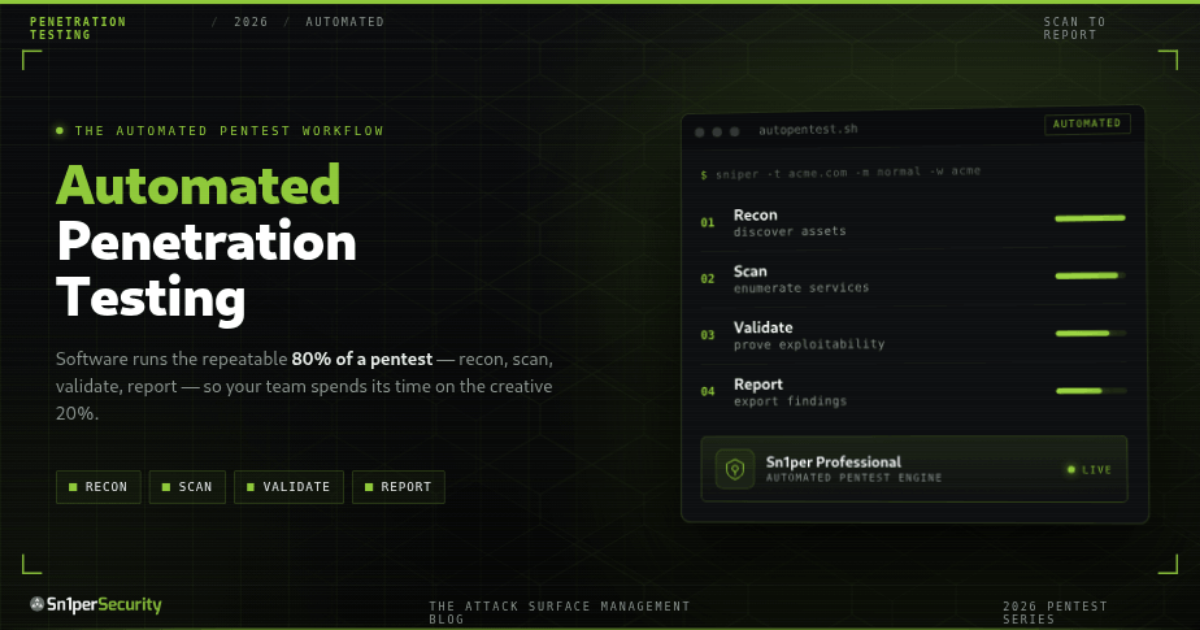

Ask ten security teams what automated penetration testing means and you will get ten answers, ranging from “a vulnerability scanner with ambitions” to “a robot that replaces my red team.” Neither is right. Automated penetration testing is the use of software to perform the repeatable parts of a penetration test – reconnaissance, enumeration, vulnerability detection, and a growing share of exploitation – continuously and at a scale no human could match, so that human testers spend their scarce time on the parts that genuinely need a human brain.
This guide defines automated penetration testing precisely, draws the honest line between what automation does well and where it still needs people, walks the automated pentest workflow stage by stage with real commands, and shows where Sn1per fits as the engine. It is the conceptual anchor for two companion guides: the best automated pentest tools and continuous penetration testing.
What is automated penetration testing?
Automated penetration testing is the practice of using software to execute penetration-testing tasks – discovering assets, fingerprinting services, matching known vulnerabilities, and attempting validated exploits – without a human driving each step. It sits between two things people often confuse it with:
- It is more than a vulnerability scanner. A scanner reports that a weakness might exist. Automated penetration testing goes further: it chains discovery into assessment and, where safe, attempts the exploit to confirm the finding is real and reachable.
- It is less than a human red team. Automation executes known techniques against the known surface brilliantly and tirelessly. It does not invent the novel business-logic abuse or the creative multi-step chain that a skilled human still finds.
The right mental model is leverage, not replacement. Automation handles the 80% of a pentest that is mechanical and repeatable so the human 20% – judgment, creativity, context – lands where it matters. For a foundational primer on the discipline itself, see our penetration testing guide.
Automated vs manual penetration testing
This is the question every team actually asks, and the honest answer is that it is not either/or. The two are complementary, and a mature program runs both. Here is how they compare on the axes that matter:
| Dimension | Automated penetration testing | Manual penetration testing |
|---|---|---|
| Speed & scale | Minutes to hours, thousands of assets | Days to weeks, scoped targets |
| Cadence | Continuous / on-demand | Periodic (often annual) |
| Coverage of known issues | Broad, consistent, repeatable | Depends on tester time |
| Novel / business-logic flaws | Limited | Strong – human creativity |
| Cost per run | Low (software) | High (expert hours) |
| Best at | Coverage, regression, speed | Depth, creativity, context |
The practical model that has emerged in 2026: automation provides the continuous floor – it covers the whole surface on every run and catches regressions and newly exposed assets – while periodic human-led testing provides the ceiling, going deep where the stakes are highest. Automation makes the human team more valuable, not redundant, because testers never burn an engagement re-confirming what a machine could have found overnight.
In practice the hybrid model looks like this: automation runs continuously and after every change, keeping the whole surface covered and the validated-exposure backlog honest; a human red team is then booked once or twice a year, or after a major release, to go deep on the crown jewels – the business-logic abuse, the creative chains, the assumptions automation cannot question. The automated layer also makes the human engagement cheaper and sharper, because the testers walk in with a current, validated map instead of spending their first days re-discovering the surface. Spend the cheap machine time on breadth and regression; spend the expensive human time on depth and creativity.
What automation does well – and what it cannot do
Being specific here prevents the two failure modes: trusting automation too much, or dismissing it entirely.
Automation excels at: asset discovery across large or unknown footprints; consistent service and technology fingerprinting; matching fingerprints to known CVEs at scale; safe, repeatable exploitation of well-understood vulnerability classes; regression testing (did the fix hold?); and running on a schedule so coverage never goes stale.
Automation still struggles with: chained business-logic abuse; context that requires understanding the application’s purpose; novel zero-day-style discovery; and judgment calls about blast radius. These are exactly where a human tester earns their fee – and why automated penetration testing is a force multiplier for red teams, not a replacement.
Common myths about automated penetration testing
Four misconceptions drive most of the bad decisions in this space:
- “It’s just a vulnerability scanner with a new name.” A scanner stops at detection. Automated penetration testing validates – it attempts the exploit and confirms reachability – so the output is a short list of proven issues, not thousands of unconfirmed maybes.
- “It will replace my red team.” It will not. It removes the repetitive 80% so your testers spend their hours on the creative 20% that only humans do. Teams that adopt automation report more value from their human testers, not less, because no engagement is wasted re-confirming the obvious.
- “It’s unsafe to run automatically.” Exploitation is the stage to gate, not the reason to avoid automation. Mature tools separate non-intrusive detection from active exploitation, and a careful rollout starts read-only (recon and detection) before enabling deeper checks against authorized scope.
- “It’s only for large enterprises.” The opposite is true. Small teams benefit most, because automation gives a one-or-two-person security function the coverage that would otherwise demand a whole department.
Strip away the myths and the definition is simple: automated penetration testing is leverage. It does not change what a penetration test is; it changes how much of one you can do, and how often you can do it.
The automated penetration testing workflow
A penetration test follows a well-known lifecycle. Automation compresses each stage from hours of manual work into a single orchestrated command. Sn1per orchestrates 90+ underlying tools so the whole chain runs into a named workspace:
1. Reconnaissance
Discover the footprint – subdomains, IP ranges, certificates, live hosts – automatically:
# Automated reconnaissance pass (no exploitation), into a workspace
sniper -t acme.com -m recon -w acme
2. Scan, detect, and validate
Enumerate services, match known vulnerabilities, and attempt validated checks in one automated run. Sn1per ships 600+ exploits and 10,000+ detections and performs active checks rather than stopping at a banner:
# Full automated pentest: recon + scan + vuln detection + validation
sniper -t acme.com -m normal -w acme

# Web-app focused automated assessment
sniper -t acme.com -m web -w acme
A single automated run collapses what would be hours of manual enumeration into a prioritized, validated result set – the “validated” line is what separates this from a scanner dump:
[*] Hosts discovered ............ 31
[*] Services enumerated ......... 88
[*] Vulnerabilities detected .... 47
[*] VALIDATED exploitable ....... 4     <-- act on these first
      - api.acme.com      RCE (confirmed)         CRITICAL
      - vpn.acme.com      CVE match (confirmed)   HIGH
      - old.acme.com      exposed admin panel     HIGH
      - staging.acme.com  default credentials     MEDIUM
Forty-seven detections triaged down to the four that are proven and reachable: that is the output a remediation team can act on without wading through false positives, and it is the core advantage of validation-driven automation over scanning alone.
3. Report and integrate
Automated testing is only useful if the output reaches the people who fix things. Sn1per Professional 2026 generates exportable Workspace and Host reports and exposes a JSON API v1.0 so findings flow into your SIEM, ticketing, or CI/CD instead of a PDF nobody opens:
# Pull validated findings straight into your own stack
curl -sk -H "X-API-Key: $SN1PER_API_KEY"
  "https://localhost:1337/api.php?action=vulnerabilities&workspace=acme"
Run that loop once and you have automated a penetration test. Run it on a schedule and you have continuous penetration testing – the natural next step.
How to implement automated penetration testing
Getting started does not require ripping out your process. A pragmatic rollout:
- Pick an all-in-one engine so you are not maintaining a brittle pipeline of a dozen separate tools (see automated pentest tools for the landscape).
- Start read-only. Run recon and detection first (
-m recon), review the output, then enable deeper assessment once you trust the scope. - Scope carefully. Define owned ranges and domains; automation is powerful, so authorization and scoping discipline matter more, not less.
- Schedule it. Move from on-demand to recurring runs so coverage stays current between human engagements.
- Wire the output into your workflow via the API so findings become tickets, not noise.
Automated penetration testing and compliance
Regulators and frameworks have caught up to the limits of annual testing. PCI DSS expects penetration testing after any significant change, not just once a year; SOC 2 auditors increasingly want evidence of ongoing validation rather than a single dated report; and exposure-management guidance from Gartner (Continuous Threat Exposure Management) treats continuous validation as the baseline. Automated penetration testing is what makes meeting those expectations economically possible – you cannot commission a manual engagement after every change, but you can run an automated one. The exportable reports and JSON API in a platform like Sn1per Professional 2026 give auditors the evidence trail (what was tested, when, and what was found) that turns continuous testing into a defensible compliance story. It is also the natural bridge to continuous penetration testing, where the cadence itself becomes the point.
Where Sn1per fits
Sn1per is an offensive-security platform that automates the full reconnaissance-to-reporting pentest workflow in one self-hosted workspace, and has done so by design since 2015. It orchestrates 90+ tools, ships 600+ exploits and 10,000+ detections, is used by 500+ teams worldwide, and performs its own active reconnaissance and validation from your egress. Three released editions share one engine:
- Sn1per Community Edition – the free, source-available command-line core. The right place to learn the automated workflow.
- Sn1per Professional 2026 – adds the self-hosted web UI, Workspace Navigator, scheduled scans, exportable reports, and a JSON API v1.0. Docker-first.
- Sn1per Enterprise – multi-workspace, multi-operator, API-first, unlimited targets.
Compare the paid editions in the Professional vs Enterprise comparison. For teams that frame this work offensively, automated penetration testing is the engine underneath red team attack surface management.
Getting started
Run an automated pentest against a domain you own. Start free with Sn1per Community Edition, run sniper -t yourdomain.com -m normal, and read the output: which findings would you, as an attacker, act on first? Then move to Sn1per Professional 2026 to schedule it and pull results via the API, or browse every edition on the shop page.
Frequently asked questions
What is automated penetration testing?
Automated penetration testing uses software to perform the repeatable parts of a penetration test – reconnaissance, enumeration, vulnerability detection, and safe, validated exploitation – continuously and at scale, without a human driving each step. It goes beyond a vulnerability scanner by validating that findings are actually exploitable, but it complements rather than replaces human-led testing.
Is automated penetration testing better than manual penetration testing?
Neither is strictly better; they are complementary. Automated testing wins on speed, scale, cadence, and consistent coverage of known issues. Manual testing wins on depth, creativity, and novel business-logic flaws. A mature program runs automation continuously as the floor and periodic human-led testing as the ceiling.
Can penetration testing be fully automated?
The repeatable majority of a pentest can be automated – discovery, enumeration, detection, and validated exploitation of known vulnerability classes. What cannot be fully automated is the creative, context-dependent work: chained business-logic abuse and novel attack paths that require human judgment. Full automation of those remains out of reach in 2026.
What is the difference between automated penetration testing and vulnerability scanning?
A vulnerability scanner detects where weaknesses might exist and produces a list of candidates. Automated penetration testing adds validation – it attempts the exploit to confirm which candidates are actually reachable and exploitable – and chains discovery through to reporting. Scanning answers where there might be a problem; automated pentesting proves which problems are real.
Does Sn1per do automated penetration testing?
Yes. Sn1per orchestrates 90+ tools to automate the full recon-to-report workflow, ships 600+ exploits and 10,000+ detections, and performs active validation rather than just detection. A single command runs the chain into a workspace, and Sn1per Professional 2026 adds scheduling and a JSON API so automated testing integrates with your existing stack.