

The annual penetration test has a structural flaw that no amount of tester skill can fix: it is a photograph of a moving target. The report is accurate the day it is written and decays from there. Cloud resources spin up, a marketing team stands up a campaign subdomain, a developer exposes a staging API “just for the demo,” a certificate expires, a new CVE drops. By the time the findings are remediated, the attack surface they described no longer exists. Continuous attack surface testing is the discipline of replacing that photograph with a live feed.
This guide explains what continuous attack surface testing is, how it maps onto the Gartner CTEM framework, how it differs from continuous monitoring and breach-and-attack simulation, and how to build an always-on testing loop with Sn1per. It is the operational companion to our pillar on Red Team Attack Surface Management.
The 48-hour window that breaks periodic testing
The case for continuous testing is a case about speed. Threat research through 2025 found that a majority of exploited vulnerabilities were weaponized within 48 hours of public disclosure – and that time-to-exploitation keeps shrinking as attackers automate. Set that against a typical testing cadence of once or twice a year and the math is brutal: for the 363 days between annual tests, new exposures sit undiscovered and unvalidated, fully visible to anyone scanning the internet.
Attackers run continuous discovery against you whether or not you run it against yourself. They monitor certificate transparency logs, scan fresh CIDR allocations, and re-check disclosed CVEs against the live internet within hours. A defender on an annual cadence is, in effect, conceding the discovery race before it starts. Continuous attack surface testing closes that gap by making your own scanning run at something closer to the attacker’s tempo.
What continuous attack surface testing actually means
Continuous attack surface testing is the scheduled, automated, repeated execution of the full red team discovery-to-validation loop, with change detection between runs. Three properties make it “continuous” rather than just “frequent”:
- Scheduled and automated. Scans run on a cadence – nightly, weekly, on every infrastructure change – without a human kicking them off. Human attention is spent on results, not on starting jobs.
- Differential. Each run is compared to the last. The signal is not the 4,000 assets that were there yesterday and are there today; it is the three that appeared overnight. Attack surface drift is the metric that matters.
- Validating. A continuous program does not just re-list assets; it re-tests them. A subdomain that was safe last week may host a vulnerable app this week. Detection without periodic re-validation is monitoring, not testing.
That third property is the line between continuous testing and the more common “continuous monitoring.” Monitoring watches for change. Testing actively probes for exploitability. Red team attack surface management needs the latter.
CTEM: the framework that operationalizes it
Continuous Threat Exposure Management (CTEM) is the program model that Gartner introduced to formalize this shift, and by 2026 it has moved from concept to operating discipline. CTEM is a continuous loop of five stages:
- Scoping. Define the business-critical assets and attack surfaces – cloud, on-prem, SaaS – that are in play. You cannot test everything equally; scoping decides where continuous attention goes.
- Discovery. Continuously identify assets, services, and vulnerabilities, rather than relying on quarterly snapshots. This is the EASM engine.
- Prioritization. Rank exposures by exploitability and actual business impact, not raw severity counts.
- Validation. Simulate or execute attack paths to confirm which exposures are genuinely reachable and exploitable – the red team and adversarial-exposure-validation contribution.
- Mobilization. Turn validated findings into routed, owned, tracked remediation.
Continuous attack surface testing is the offensive heartbeat of stages two through four. Early evidence is encouraging: a 2026 study of security professionals found that organizations running operational CTEM programs reported roughly 50% better attack surface visibility than non-adopters. The framework is not a product you buy; it is a loop you run – and Sn1per is built to run it.
Building a continuous testing loop with Sn1per
The mechanics are straightforward because Sn1per is built around named workspaces that persist between runs, which is what makes differential testing possible. Here is a minimal always-on loop.
Schedule recurring sweeps
Drive scans from cron (or any scheduler). A nightly external sweep into a persistent workspace keeps the map current:
# /etc/cron.d/sn1per-acme  -  nightly external attack-surface sweep
0 2 * * *  root  sniper -t acme.com -m web -w acme >> /var/log/sniper-acme.log 2>&1

# Weekly full discovery across an owned range, deeper and noisier
0 3 * * 0  root  sniper -t 203.0.113.0/24 -m discover -w acme-net
Detect attack surface drift
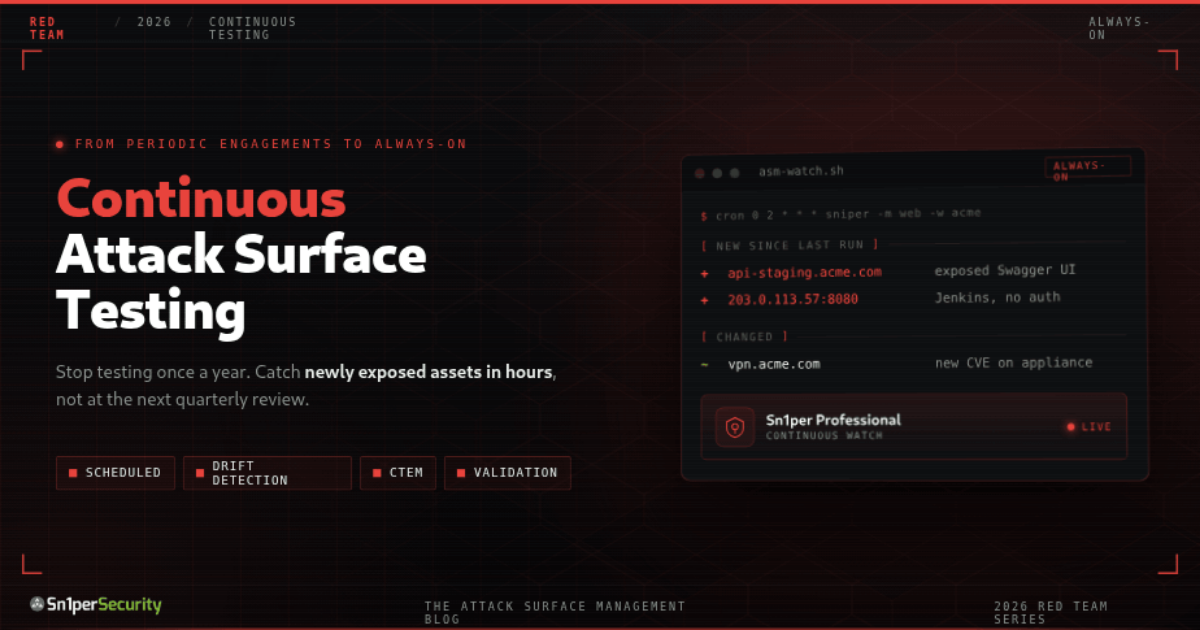
Because the workspace persists, each sweep updates the same asset set, and the platform surfaces what changed. The thing you act on is the delta:
# Re-run discovery and compare against the stored workspace baseline
sniper -t acme.com -m web -w acme

[*] NEW since last run:
    + api-staging.acme.com        (HTTP 200, exposed Swagger UI)   <-- investigate
    + 203.0.113.57:8080           (Jenkins, no auth)               <-- investigate
[*] CHANGED:
    ~ vpn.acme.com                (new CVE match on appliance fw)  <-- investigate
[*] REMOVED:
    - old-blog.acme.com           (decommissioned)
Those two NEW entries – an exposed Swagger UI and an unauthenticated Jenkins – are exactly the kind of overnight exposure a periodic test would miss for months. Catching them the next morning is the entire point.
Wire it into CI/CD and your SIEM
The JSON API v1.0 lets a continuous program push results where humans will see them. Trigger a scan on deploy, then pull findings into your SIEM or ticketing system so a new exposure becomes an alert, not a line in a log:
# Post-deploy hook: sweep the changed surface, then export findings
sniper -t acme.com -m web -w acme --noninteractive
curl -sk -H "X-API-Key: $SN1PER_API_KEY"
  "https://localhost:1337/api.php?action=vulnerabilities&workspace=acme"
  | your-siem-forwarder --source sn1per
Sn1per has supported this pattern for years; if you are starting from the older workflow, Continuous Attack Surface Management with Sn1per Professional walks through the scheduling model in more depth.
Continuous testing vs monitoring vs BAS vs the annual pentest
These terms get used interchangeably and they should not be. Here is how they actually differ:
| Approach | Cadence | Discovers new assets? | Validates exploitability? |
|---|---|---|---|
| Annual / periodic pentest | 1-2x per year | Yes, at test time only | Yes, but instantly stale |
| Continuous monitoring | Always-on | Yes | No – watches for change |
| Breach & attack simulation | Scheduled | No – tests known assets | Partial – simulated TTPs |
| Continuous attack surface testing | Always-on | Yes | Yes – re-validates each run |
Continuous attack surface testing is the only row that does all three: always-on, discovers the unknown, and proves exploitability on every pass. It is periodic red teaming, minus the periodic.
What continuous testing catches that a pentest misses
The abstract case for continuous testing becomes concrete the first time it catches something a calendar never would. Three recurring examples:
- The subdomain you did not authorize. A team spins up
promo.acme.comfor a two-week campaign on a cloud host with default settings. It appears in certificate transparency logs within minutes of the TLS certificate being issued – and a continuous program that watches those logs sees it the same day, while the next scheduled pentest is still months away. - The ephemeral asset with a real foothold. A developer exposes a staging API “just for a demo,” complete with debug endpoints and no authentication. It is live for days, not for the duration of an engagement. Continuous discovery is the only testing model whose timing can even intersect with its existence.
- The new CVE on an asset you already knew about. Your VPN appliance was clean at the last test. A critical vulnerability drops, and within 48 hours it is being exploited in the wild. Continuous re-validation re-tests the known surface against the new threat and flags the appliance before it becomes an incident, instead of waiting for the next engagement to notice.
None of these are exotic. They are the ordinary churn of a live environment – and they are precisely the gaps a point-in-time test is structurally blind to.
Metrics that prove the program is working
If you run continuous testing, measure it with metrics an attacker would respect:
- Mean time to detect new exposure. How long from an asset appearing to your program flagging it? The target is hours, not the months a quarterly cadence implies.
- Attack surface drift. How many assets appear, change, or disappear per week? High drift with low visibility is the danger zone.
- Time to validation. How long from detecting a potential exposure to proving whether it is exploitable? Detection without validation is an unanswered question.
- Validated exposure backlog. Not total findings – the count of confirmed-exploitable exposures still open. This is the number that maps to real risk.
Why continuous programs stall – and how to keep yours running
Most continuous testing programs do not fail technically; they fail operationally. Three patterns account for the majority of stalled efforts:
- Alert fatigue from undifferentiated output. If every run dumps the full asset list instead of the delta, operators tune it out within weeks. The fix is to report only what changed, and to route confirmed-exploitable exposures into a separate, higher-priority lane than raw discovery noise.
- Scope that never includes the ephemeral. Continuous testing that only covers a static list of known domains misses exactly the assets it exists to catch – the campaign subdomain, the demo environment, the cloud instance that lived for six hours. Scope by owned IP ranges and certificate patterns, not by a hand-maintained host list that goes out of date the moment a developer ships.
- Discovery without validation. A program that flags new assets but never tests them has quietly become monitoring by another name. Budget compute for periodic re-validation, not just re-discovery, or the “testing” in continuous attack surface testing disappears while the dashboard still looks busy.
The common thread is a division of labor: automation handles volume, humans handle judgment. A healthy program spends machine time on discovery and validation, and human time only on the short, evidenced queue that survives both. When that balance slips – when humans are starting scans or triaging raw output by hand – the program is one busy week away from being abandoned.
Getting started
Begin with one workspace and one schedule. Map a domain you own with Sn1per Community Edition, put the command in cron, and run it nightly for a week – then look only at the deltas. The first time a continuous sweep catches a staging host that went up Tuesday and was forgotten by Wednesday, the value is self-evident. Move to Sn1per Professional 2026 for the web UI, scheduled-scan management, and the API, or scale to multi-operator coverage with Sn1per Enterprise.
For the strategy behind the loop, start with the pillar, Red Team Attack Surface Management; for the validation half of the equation, read Adversarial Exposure Validation.
Frequently asked questions
What is continuous attack surface testing?
It is the scheduled, automated, repeated execution of the full attack-surface discovery-to-validation loop, with change detection between runs. Rather than testing once or twice a year, you scan continuously, compare each run to the last to catch newly exposed assets, and re-validate exploitability on every pass. It is the offensive engine of a Continuous Threat Exposure Management (CTEM) program.
How is continuous testing different from continuous monitoring?
Monitoring watches for change and alerts you when something appears or shifts. Testing goes a step further and actively probes assets for exploitability. A monitoring tool tells you a new subdomain went live; a continuous testing program tells you that subdomain is running a vulnerable, exploitable application. Red team attack surface management requires the testing depth, not just the monitoring signal.
What is CTEM and how does it relate to attack surface testing?
Continuous Threat Exposure Management (CTEM) is a Gartner framework with five stages – scoping, discovery, prioritization, validation, and mobilization – that turns periodic security testing into an always-on loop. Continuous attack surface testing is the offensive work that powers CTEM’s discovery, prioritization, and validation stages.
How often should attack surface testing run?
As often as your surface changes, which for most organizations means at least nightly for external discovery and on every infrastructure change for the affected scope. Because exploited vulnerabilities are frequently weaponized within 48 hours of disclosure, a cadence measured in weeks or months leaves long windows of undetected exposure.
Can Sn1per run scheduled, continuous scans?
Yes. Sn1per uses persistent named workspaces, so scans can be driven from cron or a CI/CD pipeline and each run updates the same asset set, surfacing what changed. Sn1per Professional 2026 adds scheduled-scan management in the web UI and a JSON API v1.0 to export findings into a SIEM or ticketing system.