
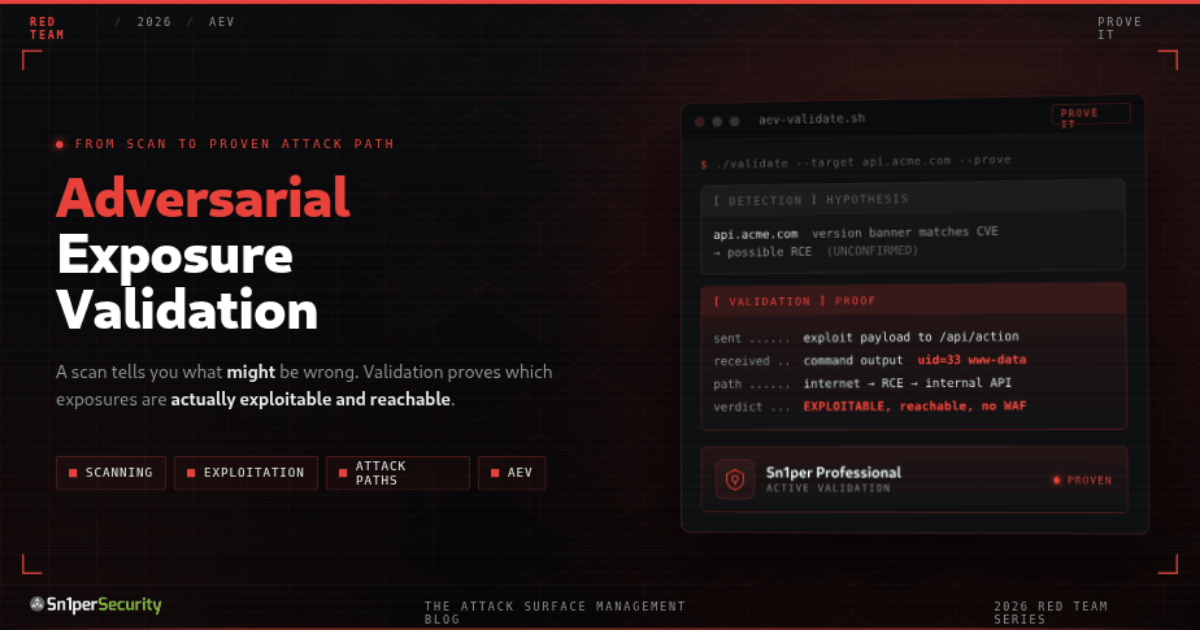

A scan that returns 12,000 findings has not told you what to fix. It has told you that you have a triage problem. The hardest question in attack surface management is not what is exposed – modern scanners answer that exhaustively – but which exposures actually matter. Adversarial Exposure Validation (AEV) is the discipline that answers it: instead of trusting that a detected weakness is real and reachable, you prove it the way an attacker would, by attempting the exploit and following the chain.
This guide explains what AEV is, how attack surface scanning feeds it, and how a red team turns a raw scan into a short list of proven attack paths – with the Sn1per commands that do each step. It is the validation half of our pillar on Red Team Attack Surface Management.
What is Adversarial Exposure Validation?
Adversarial Exposure Validation is an offensive methodology, recognized by Gartner as a core component of Continuous Threat Exposure Management, that confirms whether discovered exposures are genuinely exploitable. It is the umbrella that unifies several offensive techniques toward one goal – proof:
- External attack surface management supplies the inventory of what is exposed.
- Vulnerability scanning flags where weaknesses might exist.
- Penetration testing and red teaming attempt the exploit and chain the path.
- Breach and attack simulation checks whether existing controls would stop a known technique.
AEV ties these together into a continuous validation loop. The output is not a longer list of possible problems – it is a shorter list of confirmed ones, each with evidence. That inversion, from “here is everything that could be wrong” to “here is what is provably wrong and reachable,” is the most valuable thing an offensive program produces.
Attack surface scanning is step one, not the finish line
Attack surface scanning – the active and passive probing that enumerates your exposed assets and their weaknesses – is the necessary first move. You cannot validate what you have not found. But scanning alone has a well-known failure mode: it produces volume without verdict.
A scanner reports that a host responds to a request in a way consistent with a known CVE. That is a hypothesis, not a fact. The service might be patched against that specific vector, sitting behind a WAF that blocks the payload, or simply not reachable in the way the scanner assumed. Treat every such finding as real and you flood your remediation queue with false positives; ignore them and you miss the real ones. The way out is to validate – to send the actual exploit and see what happens.
Attack surface scanning techniques and tools
A complete scan layers several techniques, each surfacing assets the others miss:
- Passive reconnaissance. Certificate transparency logs, DNS records, and public datasets reveal assets without sending a packet to the target. Tools like OWASP Amass excel here.
- Active discovery. Port and service scanning (Nmap and friends) confirms what is actually live and listening.
- Technology fingerprinting. Identifying the software, versions, and frameworks behind each service – the input to known-vulnerability matching.
- Vulnerability detection. Template-based engines (such as Nuclei) and curated checks match fingerprints against known issues at scale.
An attack surface scanner built for offensive work runs all four and then hands off to validation. Sn1per orchestrates 90+ such tools so the scanning layer is a single command rather than a pipeline you assemble and maintain by hand – and the open-source building blocks are covered in Open-Source & Self-Hosted ASM Tools.
From scan to proven attack path
Here is the AEV pipeline in practice. Step one scans the surface; step two stops trusting the scan and starts proving it.
# 1. SCAN - enumerate the external surface and detect candidate weaknesses
sniper -t acme.com -m web -w acme

# 2. VALIDATE - actively verify the prioritized findings, not just detect them
sniper -t acme.com -m massvulnscan -w acme

# 3. CHAIN - confirm the path from foothold to impact across the workspace
sniper -t acme.com -m airstrike -w acme
The difference between step one and step two is the difference between AEV and ordinary scanning. Sn1per ships 600+ exploits and 10,000+ detections and performs active checks – it sends the request that confirms exploitability rather than inferring it from a version banner. A validated finding carries evidence: the request, the response, and the proof that the exposure is reachable and real.
AI-assisted validation, kept in your perimeter
Validation is also where AI is making its biggest near-term contribution to offensive work – triaging which detections are worth an exploit attempt, and reasoning about multi-step chains. The risk is shipping your traffic and findings to a third-party model. SILENTCHAIN AI Community Edition performs active verification of web findings and supports a local Ollama runtime, so the AI analysis runs in your perimeter alongside Sn1per rather than in someone else’s cloud.
Why validation beats a longer vulnerability list
The practical payoff of AEV is prioritization that an attacker would agree with. A vivid example from exposure-management practice: a surface that throws off thousands of theoretical vulnerabilities often reduces, under validation, to a mere handful of attack paths that can actually reach critical data. Fix those few first and you have cut real risk far more than by grinding down a CVSS-sorted backlog of mostly unreachable findings.
There is a hard economic argument here too. Every unvalidated finding that reaches a remediation team costs analyst hours to investigate, and most of those hours end up confirming that the finding was not exploitable after all. A program that validates before it escalates spends cheap machine time to save expensive human time – it routes people only the exposures that survived an actual exploit attempt. At the scale of a modern attack surface, that is the difference between a security team that keeps pace with its own exposure and one that is permanently buried under it.
This is why the 2026 conversation has moved from “how many vulnerabilities do we have” to “how many validated, reachable attack paths do we have.” The first number is large, demoralizing, and mostly noise. The second is small, actionable, and the one that maps to whether you get breached.
What a validated finding looks like
The difference between a detection and a validation is evidence. A scanner-only finding reads like a hypothesis; a validated finding reads like a case file. Consider the same exposed service described both ways:
[DETECTION]  api.acme.com - web framework version banner matches a known CVE
             Possible remote code execution - severity HIGH (UNCONFIRMED)

[VALIDATION] api.acme.com - CVE CONFIRMED exploitable
             Sent ......... crafted payload to /api/action
             Received ..... command output in HTTP response (id -> uid=33 www-data)
             Reachable .... yes - no WAF interception observed
             Attack path .. internet -> RCE -> internal API segment
The detection tells a remediation team there might be a problem and leaves them to confirm it – which, multiplied across thousands of findings, is how backlogs become permanent. The validation hands them proof: the exact request, the observed response, and the resulting position in the network. That finding cannot be waved away as a false positive, and it can be ranked honestly against other proven paths. It is also why validated findings travel well into a SIEM or ticketing system – each one arrives with the context that makes it immediately actionable, rather than as one more unverified row a human has to investigate before anyone can act.
AEV vs vulnerability scanning vs BAS vs pentest
| Method | Question it answers | Output | Continuous? |
|---|---|---|---|
| Vulnerability scanning | Where might weaknesses exist? | Large list of candidates | Can be |
| Breach & attack simulation | Would my controls stop known TTPs? | Control pass/fail | Yes |
| Penetration test | Can a human break in right now? | Proven findings, point-in-time | No |
| Adversarial Exposure Validation | Which exposures are provably exploitable and reachable? | Short list of validated attack paths | Yes |
AEV is not a replacement for these techniques – it is the layer that makes their output trustworthy by demanding proof. It combines the breadth of scanning, the rigor of a pentest, and the cadence of simulation.
Where automated validation ends and human red teaming begins
Honesty about the method matters: adversarial exposure validation automates the known, but it does not replace human creativity. Automated validation is exceptional at proving whether a catalogued weakness is exploitable, at a breadth and cadence no human team can match. What it does not do well – yet – is invent the genuinely novel attack path: the business-logic flaw no template anticipates, the chained misconfiguration that only makes sense in context, the pivot that turns a low-severity finding into a breach.
The mature model is not automation versus humans; it is automation handling coverage so humans can spend their scarce, expensive creativity where it counts. AEV runs continuously against the entire known surface and keeps the validated-exposure backlog honest. Periodic human-led red teaming then goes deep on the crown jewels, probing for the creative paths that only an adversary’s imagination finds. The platform makes the human team more valuable, not redundant, by ensuring they never burn an engagement re-confirming what a machine could have validated overnight. Treat AEV as the continuous floor under your security posture, and human red teaming as the periodic ceiling that pushes it higher.
Where Sn1per fits
Sn1per is an offensive-security platform that runs the entire scan-to-validation pipeline in one self-hosted workspace – it has done so by design since 2015. It orchestrates 90+ tools for the scanning layer, then applies 600+ exploits and 10,000+ detections to validate what it finds, and presents the result as evidenced, prioritized findings rather than an undifferentiated dump. Because it performs its own active reconnaissance and exploitation from your egress, the validation capability runs anywhere – including segmented and air-gapped networks where SaaS validation tools cannot reach.
- Sn1per Community Edition – free, source-available CLI for the scanning and validation core.
- Sn1per Professional 2026 – adds the web UI, scheduled re-validation, exportable reports, and a JSON API v1.0.
- Sn1per Enterprise – multi-operator, multi-workspace validation at scale.
Getting started
Run the pipeline against a domain you own and watch the list shrink. Scan with Sn1per Community Edition, then validate the top findings and count how many survive an actual exploit attempt – that surviving set is your real attack surface. Move to Sn1per Professional 2026 to make validation continuous and exportable, or browse every edition on the shop page.
To put validation in its strategic context, read the pillar, Red Team Attack Surface Management; to keep the validation loop running continuously, read Continuous Attack Surface Testing.
Frequently asked questions
What is adversarial exposure validation (AEV)?
Adversarial Exposure Validation is an offensive security methodology, recognized by Gartner as part of Continuous Threat Exposure Management, that confirms whether discovered exposures are genuinely exploitable. Rather than trusting that a detected weakness is real, AEV attempts the exploit and follows the attack path, combining external attack surface management, vulnerability scanning, penetration testing, red teaming, and breach-and-attack simulation into one validation loop.
How is AEV different from vulnerability scanning?
Vulnerability scanning detects where weaknesses might exist and produces a large list of candidates, many of which are not actually exploitable. AEV takes those candidates and proves which ones are real and reachable by attempting the exploit. Scanning answers “where might there be a problem;” AEV answers “which problems are provably exploitable.”
What is attack surface scanning?
Attack surface scanning is the active and passive probing that enumerates an organization’s exposed assets and their potential weaknesses – subdomains, IPs, open ports, services, technologies, and known vulnerabilities. It layers passive reconnaissance, active discovery, technology fingerprinting, and vulnerability detection. It is the essential first step of adversarial exposure validation, but on its own it produces unverified findings.
Does AEV replace penetration testing?
No. AEV incorporates penetration testing techniques and makes them continuous and validating, but a skilled human red team still finds novel, creative attack paths that automation does not. The practical model is AEV running continuously to validate the known surface, with periodic human-led red teaming for depth and creativity.
Can Sn1per validate exploitability, not just detect issues?
Yes. Sn1per performs active validation – it ships 600+ exploits and 10,000+ detections and sends the requests that confirm whether a finding is exploitable, rather than inferring risk from a version banner. Validated findings carry the evidence of the attempt, so remediation teams act on proof rather than on a list of possibilities.