
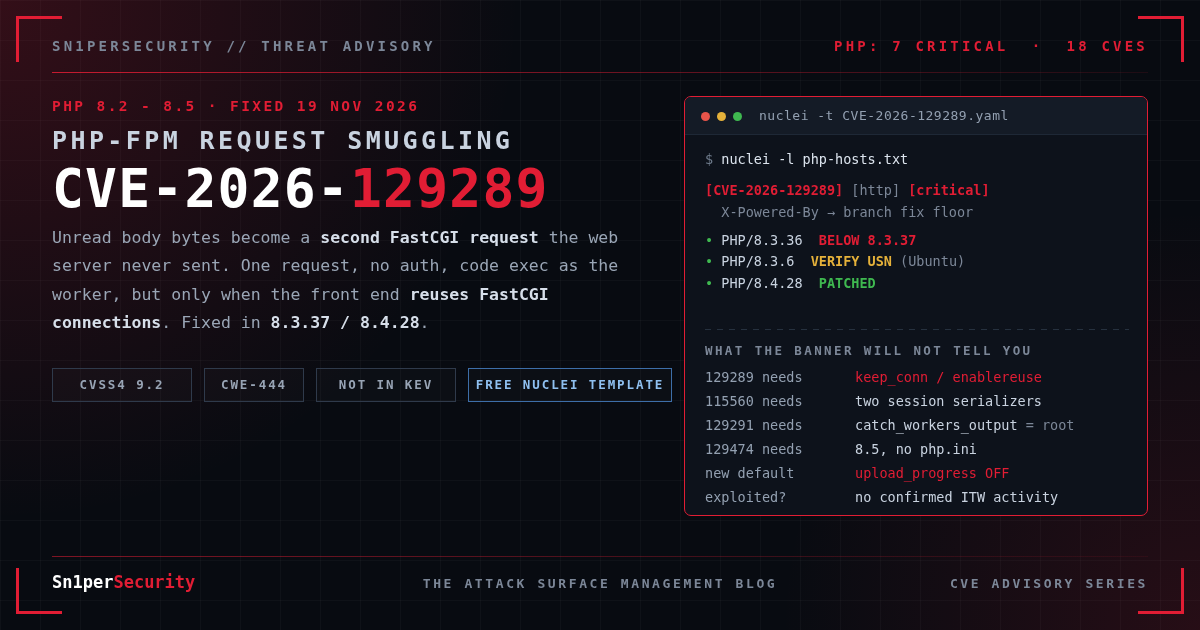

CVE-2026-129289 is a request smuggling flaw in PHP-FPM that lets an unauthenticated attacker run PHP code on the server with a single HTTP request, provided the web server in front of PHP keeps its FastCGI connections open between requests. It is one of 18 vulnerabilities fixed on 19 November 2026 in PHP 8.5.13, 8.4.28, 8.3.37 and 8.2.36, released the same afternoon as PHP 8.6.0. The PHP security team rates the headline issues CVSS v4.0 9.2 Critical, and says in the same breath that most of them need a non-default configuration or an uncommon setup.
That second sentence is the whole story of this release, and it is why this post is three things. First, a plain-English explanation of the issues that actually matter, with the exact configuration that turns each one from a patch gap into an emergency. Second, a free, non-destructive Nuclei template that finds every PHP host below its fix floor without sending anything that touches the bugs. Third, a local audit script that checks for those configurations, because a version banner can tell you that you need to patch but it can never tell you how urgently. The FPM smuggling issue was reported through PHP’s GitHub security advisory process and is tracked as GHSA-qc49-hpvq-g2w6.
One rule first: do not try to trigger any of these to “confirm” them. Several are memory corruption bugs that crash workers when they fail, and the smuggling issue, when it succeeds, is code execution on someone’s production server. Every check in this post is a banner read or a configuration read.
CVE-2026-129289 at a glance
- CVE / advisory: CVE-2026-129289, GHSA-qc49-hpvq-g2w6, “PHP-FPM request smuggling through an unread HTTP request body”
- CWE: CWE-444 (inconsistent interpretation of HTTP requests) and CWE-670
- Impact: unauthenticated PHP code execution as the FPM worker, plus routing bypass, forged client address and persistent
PHP_ADMIN_VALUEchanges for later requests on the same worker - CVSS v4.0: 9.2 Critical,
CVSS:4.0/AV:N/AC:L/AT:P/PR:N/UI:N/VC:H/VI:H/VA:H/SC:N/SI:N/SA:N(PHP security team, the CNA). NVD status is Awaiting Analysis with no score of its own. - Precondition: the front end reuses FastCGI connections (nginx
fastcgi_keep_conn on, Apachemod_proxy_fcgiwithenablereuse=on, HAProxy FastCGI with connection reuse). Both nginx and Apache settings are off by default. - Affected: every PHP-FPM build from 5.6.0 up to the fixed releases
- Fixed: 8.2.36, 8.3.37, 8.4.28, 8.5.13, and 8.6.0
- Exploitation: not in CISA KEV (catalog 2026.11.20); no public exploit we could verify. GitHub repositories claiming proof-of-concept code appeared within two days of disclosure; they are unreviewed and should not be run
- Fix now: upgrade and restart every FPM master; until then confirm connection reuse is off
What else is in the November 2026 PHP release
CVE-2026-129289 is the one with the cleanest attack path, but it is not the only critical in the release. Counting from the GitHub Security Advisory records, seven issues carry a Critical label and all seven are scored 9.2. DigitalOcean’s customer notice and some early coverage say six. The difference is that two of the seven exist only on PHP 8.5, so the count depends on which branch you are describing. The table below is the full set, with the configuration each one depends on.
| CVE | Title (abridged) | CVSS 4.0 | Branches | What has to be true |
|---|---|---|---|---|
| CVE-2026-129289 | PHP-FPM request smuggling via unread body | 9.2 | all | Front end keeps FastCGI connections open |
| CVE-2026-115560 | Session serializer mismatch to RCE | 9.2 | all | Upload progress on, and two serializers share one session store |
| CVE-2026-126714 | Partially overwritten session files | 9.2 | all | files handler, an interrupted write, a gadget chain |
| CVE-2026-129496 | Timezone cache use-after-free | 9.2 | all | A startup diagnostic written to a PHP error_log file |
| CVE-2026-129481 | Use-after-free after interrupted session shutdown | 9.2 | 8.3+ | A fatal error inside session cleanup callbacks |
| CVE-2026-129474 | Use-after-free in magic method backtraces | 9.2 | 8.5 only | zend.exception_ignore_args=0, i.e. no production php.ini |
| CVE-2026-129182 | Stale last_fatal_error_backtrace after shutdown |
9.2 | 8.5 only | Specific per-directory INI overrides |
| CVE-2026-129291 | PHP-FPM epoll use-after-free to root | 8.8 | 8.2.7+ | Code execution in a worker, catch_workers_output on |
| CVE-2026-127960 | Folded HTTP response header DoS | 8.7 | 8.2.28+ | App fetches an attacker-controlled URL via stream wrappers |
| CVE-2026-128064 | HTTPS:// with uppercase S sent in plaintext |
8.2 | all | Mixed-case scheme reaches a stream wrapper, or a redirect does |
| CVE-2026-128090 | Phar OpenSSL signature downgrade | 7.7 | all | App trusts an OpenSSL-signed phar it does not control |
| CVE-2026-129538 | PHP-CGI PATH_INFO out-of-bounds read/write | 6.9 | all | The php-cgi SAPI |
| CVE-2026-129292 | FPM status page XSS | 5.3 | all | FPM status page rendered as HTML |
| CVE-2026-129506, 129501, 15353, 129438, 48841 | SOAP, DOM, URI and bundled uriparser issues | 6.3 and below | varies | Specific extension use |
Branch totals from the official ChangeLog: 18 CVEs in 8.5.13, 14 in 8.4.28, 13 in 8.3.37 and 12 in 8.2.36. One small inconsistency worth knowing about: the CVE-2026-127960 advisory text says the bug arrived in 8.3.19, while its machine-readable range starts at 8.3.18. Use the wider range.
What is CVE-2026-129289?
FastCGI is the protocol a web server uses to hand a request to PHP-FPM. One FastCGI connection can carry many requests in sequence, but only if both sides agree exactly where one request ends and the next begins. That agreement is what broke.
When PHP finishes a request, it has to throw away any part of the HTTP request body the application never read, or close the connection. PHP reads php://input lazily. During shutdown, PHP treated the mere existence of a php://input stream as proof that the body had already been handled, and skipped the cleanup that discards unread bytes. The advisory is precise about this: the flaw was introduced with lazy php://input handling in PHP 5.6.0.
An attacker combines that with a malformed multipart/form-data body that makes PHP’s multipart parser stop at a predictable offset. If the application opens php://input without reading it to the end, the leftover bytes stay inside the current backend request. That is not exotic. Request frameworks routinely create an input stream before routing or authentication, even for endpoints that never use the body.
The last step is the connection reuse. When FCGI_KEEP_CONN is set, PHP-FPM keeps the connection and starts parsing the next FastCGI request. The vulnerable code forgot that it was still inside an FCGI_STDIN record, so bytes placed at the right offset in the HTTP body are accepted as a brand new FastCGI request that the web server never created or authorised.
A FastCGI request carries its own parameters, including SCRIPT_FILENAME, REMOTE_ADDR and PHP_ADMIN_VALUE. Control of PHP_ADMIN_VALUE is control of administrator-level PHP settings, which is why the advisory describes the outcome as code execution “without another user’s interaction or a non-default PHP configuration”. The only non-default part is on the web server side. The advisory also notes that it does not need memory corruption, address leaks or a race, which is what makes it more reliable than anything else in this release.
LSAPI (LiteSpeed) shares the cleanup error and can be desynchronised, but the PHP_ADMIN_VALUE chain is a FastCGI mechanism, and the advisory does not establish code execution through LSAPI.
Affected and fixed versions
| Branch | Affected | Fixed | Notes |
|---|---|---|---|
| PHP 8.6 | 8.6.0 alpha, beta and RC builds | 8.6.0 GA | GA shipped 19 Nov 2026 with the same fixes |
| PHP 8.5 | < 8.5.13 | 8.5.13 | All 18 CVEs apply |
| PHP 8.4 | < 8.4.28 | 8.4.28 | 14 CVEs |
| PHP 8.3 | < 8.3.37 | 8.3.37 | 13 CVEs |
| PHP 8.2 | < 8.2.36 | 8.2.36 | 12 CVEs; security support ends 2026-12-31 |
| PHP 8.1 and older | all | none | End of life; CVE-2026-129291 and 127960 are listed for 8.1 with no patched version |
Distribution packages need separate treatment, and this is where version scanners go wrong:
| Distribution | Fixed package | What the banner says |
|---|---|---|
| Ubuntu 24.04 noble | php8.3 8.3.6-0ubuntu0.24.04.14 |
8.3.6, far below 8.3.37 |
| Ubuntu 22.04 jammy | php8.1 8.1.2-1ubuntu2.29 |
8.1.2, looks end of life |
| Debian 12 bookworm | php8.2 8.2.36-1~deb12u1 (DLA-4916-1) |
8.2.36, accurate |
| Debian 13 trixie | php8.4 8.4.28-1~deb13u1 |
8.4.28, accurate |
| Official Docker images | php:8.4.28-*, php:8.5.13-* |
accurate |
Ubuntu freezes the upstream version for the life of a release and backports fixes into it, so a fully patched noble host still says 8.3.6. Debian now ships the real upstream point releases in its security suites, so its banners can be trusted. The Ubuntu tracker entry for CVE-2026-129289 also rates it medium priority, not critical, which is a reasonable reading of a bug whose trigger is a non-default web server setting. Two scorers, two answers. Defend for the worse one if your front end reuses connections, and for the milder one if it does not.
And as always: an update approved in your package manager or patch tool is not an update installed, and an installed package is not a patched process. PHP-FPM masters and Apache with mod_php keep the old code in memory until they restart.
How the exploit chain works
The shape of a CVE-2026-129289 attack, with every payload position removed:
POST /any/existing/route HTTP/1.1
Host: victim.example
Content-Type: multipart/form-data; boundary=[REDACTED]
Content-Length: [REDACTED]

[REDACTED: malformed multipart preamble that stops PHP's parser at a known offset]
[REDACTED: bytes positioned to be read by PHP-FPM as a second FastCGI request,
           carrying its own SCRIPT_FILENAME and PHP_ADMIN_VALUE parameters]
Nothing in that request is unusual to the web server. It is an ordinary POST to a route that exists, and the web server forwards it to PHP-FPM over a connection it intends to reuse. The forged request lives entirely inside the body. The front end never sees a second request, so access rules, rate limits and WAF rules applied at the web server never evaluate it. The advisory adds that settings changed this way can stay active for later requests served by the same worker, so the effect outlives the attacking request.
We are deliberately not publishing a working exploit, the FastCGI record layout or the multipart offsets here. That is consistent with every advisory in this series, including our write-up of php2shell, CVE-2026-109618 and CVE-2026-109619, the October PHP release that this one partly follows up.
The two session bugs, and the default that changed
CVE-2026-115560 will look familiar if you read the October advisories. On 23 October php.net posted an informational advisory suggesting session.upload_progress.enabled=0 “to fully protect from an unlikely RCE vector”. This is that vector, now with a CVE.
Session upload progress writes the value of a PHP_SESSION_UPLOAD_PROGRESS form field into the session. If the writer uses the php_binary or php_serialize serializer and something later reads the same session with the php serializer, the reader can be tricked into treating part of a session key as serialized object data. With a suitable gadget chain in the reading application, that is code execution. The advisory reports command execution with a Guzzle gadget on 8.2.35, 8.3.36, 8.4.27 and 8.5.12, and with a Monolog gadget in another setup.
The part that catches people out: you do not need an application that switches serializers at runtime. Two pools, two vhosts or a cron job with different INI files writing into one session directory is enough. Separate FPM pools do not get separate session storage unless you configure it.
The fix changes a default. After this release, session upload progress is off by default, and PHP rejects runtime changes to session settings while it is enabled. If your php.ini or a pool explicitly sets session.upload_progress.enabled=1, that explicit setting wins and the path stays open, so search for it. And per the advisory, if you do keep the feature on, every reader and writer of that session store must use the same session.serialize_handler even after you patch, because the fix does not enforce matching serializers across separate configurations.
CVE-2026-126714 is the second session issue and it does not depend on upload progress at all. PHP’s default files handler wrote new session data over the old file without truncating it first, so a write interrupted halfway left a file that was half new session and half old. Carefully arranged, that combination deserializes differently from either original. It needs an interruption at the right moment, which the advisory notes is easiest on threaded (ZTS) builds, plus a gadget chain. It is real but hard. The fix truncates before writing.
Am I affected? Quick manual checks
Start on the host, because that is where the answer is authoritative. The installed version first, then the running one:
php -v | head -1
php-fpm8.3 -v | head -1            # adjust to your branch
dpkg -l 'php*' | awk '/^ii/{print $2, $3}'    # Debian / Ubuntu
rpm -qa 'php*'                                  # RHEL family
ps -o lstart,args -C php-fpm8.3 | head -3       # started before you patched?
Then the configuration that decides urgency. For CVE-2026-129289, look for connection reuse in the web server. On Debian and Ubuntu the Apache conf-enabled entries are symlinks, so use grep -R, not grep -r, or you will get a clean result that means nothing:
sudo grep -RniE 'fastcgi_keep_conn\s+on' /etc/nginx/
sudo grep -RniE 'enablereuse\s*=\s*on' /etc/apache2/ /etc/httpd/ 2>/dev/null
A stock SetHandler "proxy:unix:/run/php/php8.3-fpm.sock|fcgi://localhost" with no matching <Proxy> block that sets enablereuse=on does not reuse connections.
For CVE-2026-115560, compare every serializer that can touch one session store, and check upload progress:
sudo grep -RniE 'serialize_handler|upload_progress|session\.save_path' \
     /etc/php/ /usr/local/etc/php* 2>/dev/null | grep -v ';'
For CVE-2026-129291, check FPM pools for worker output capture and who the master runs as:
sudo grep -RniE '^\s*catch_workers_output' /etc/php/*/fpm/pool.d/ /usr/local/etc/php-fpm.d/ 2>/dev/null
ps -eo user,args | grep '[p]hp-fpm: master'
The official PHP-FPM Docker images enable catch_workers_output, which the advisory calls out by name. We confirmed it: php:8.4.27-fpm ships catch_workers_output = yes in /usr/local/etc/php-fpm.d/docker.conf, with the master running as root inside the container. Distribution pools usually ship it commented out, but it is a common tweak for getting PHP errors into a container’s log stream, so check rather than assume.
For PHP 8.5 and CVE-2026-129474, confirm a production php.ini is actually loaded. The official Docker images ship without one, and without it zend.exception_ignore_args falls back to 0:
php --ini | head -2
php -r 'var_dump(ini_get("zend.exception_ignore_args"));'
From the outside, the only safe signal is the X-Powered-By header that PHP adds when expose_php is on. It tells you the version and nothing about the SAPI, the front end or the configuration. A version below the floor is a patch gap. Whether it is an emergency is a question only the host can answer.
Nuclei detection template for CVE-2026-129289
The template reads one header from one GET request. It sends no multipart body, no FastCGI record and no session cookie. The matchers are mutually exclusive, so every host produces exactly one result line, and the matcher name tells you which branch and fix floor applied.
id: CVE-2026-129289

info:
  name: PHP - November 2026 Security Release Patch Gap (CVE-2026-129289, CVE-2026-115560 and 16 more)
  author: xer0dayz
  severity: critical
  description: |
    PHP below 8.2.36, 8.3.37, 8.4.28 and 8.5.13 is affected by the November
    2026 PHP security release, headed by CVE-2026-129289 (PHP-FPM request
    smuggling to RCE when the front end reuses FastCGI connections). A match
    is a PATCH GAP, not proof of exploitability. NON-DESTRUCTIVE: one GET,
    reads X-Powered-By, sends no payload. Ubuntu frozen bases (8.1.2, 8.3.6,
    8.5.4, 8.5.9) are reported separately for a manual USN check.
  remediation: |
    Update to 8.2.36, 8.3.37, 8.4.28, 8.5.13 or 8.6.0 and restart every
    PHP-FPM master and Apache process. Session upload progress is now off by
    default; an explicit enabled=1 overrides that.
  reference:
    - https://github.com/php/php-src/security/advisories/GHSA-qc49-hpvq-g2w6
    - https://github.com/php/php-src/security/advisories/GHSA-658j-r8rw-q6mx
    - https://www.php.net/ChangeLog-8.php
    - https://nvd.nist.gov/vuln/detail/CVE-2026-129289
  classification:
    cvss-metrics: CVSS:4.0/AV:N/AC:L/AT:P/PR:N/UI:N/VC:H/VI:H/VA:H/SC:N/SI:N/SA:N
    cvss-score: 9.2
    cve-id: CVE-2026-129289,CVE-2026-115560,CVE-2026-126714,CVE-2026-129496,CVE-2026-129481,CVE-2026-129474,CVE-2026-129182,CVE-2026-129291
    cwe-id: CWE-444,CWE-670
  metadata:
    verified: false
    max-request: 1
    vendor: php
    product: php
    shodan-query: "X-Powered-By: PHP/"
  tags: cve,cve2026,php,php-fpm,rce,request-smuggling,unauth,patch-gap

http:
  - method: GET
    path:
      - "{{BaseURL}}"

    redirects: true
    max-redirects: 2

    matchers-condition: or
    matchers:
      - type: dsl
        name: ubuntu-frozen-base-verify-usn
        dsl:
          - "regex('^PHP/(8\\.1\\.2|8\\.3\\.6|8\\.5\\.4|8\\.5\\.9)([^0-9.]|$)', xpb)"

      - type: dsl
        name: php-82-below-8.2.36
        dsl:
          - "!regex('^PHP/(8\\.1\\.2|8\\.3\\.6|8\\.5\\.4|8\\.5\\.9)([^0-9.]|$)', xpb) && compare_versions(replace_regex(xpb, '^PHP/([0-9]+\\.[0-9]+\\.[0-9]+).*$', '$1'), '>= 8.2.0', '< 8.2.36')"

      - type: dsl
        name: php-83-below-8.3.37
        dsl:
          - "!regex('^PHP/(8\\.1\\.2|8\\.3\\.6|8\\.5\\.4|8\\.5\\.9)([^0-9.]|$)', xpb) && compare_versions(replace_regex(xpb, '^PHP/([0-9]+\\.[0-9]+\\.[0-9]+).*$', '$1'), '>= 8.3.0', '< 8.3.37')"

      - type: dsl
        name: php-84-below-8.4.28
        dsl:
          - "compare_versions(replace_regex(xpb, '^PHP/([0-9]+\\.[0-9]+\\.[0-9]+).*$', '$1'), '>= 8.4.0', '< 8.4.28')"

      - type: dsl
        name: php-85-below-8.5.13
        dsl:
          - "!regex('^PHP/(8\\.1\\.2|8\\.3\\.6|8\\.5\\.4|8\\.5\\.9)([^0-9.]|$)', xpb) && compare_versions(replace_regex(xpb, '^PHP/([0-9]+\\.[0-9]+\\.[0-9]+).*$', '$1'), '>= 8.5.0', '< 8.5.13')"

      - type: dsl
        name: php-86-prerelease-below-8.6.0
        dsl:
          - "regex('^PHP/8\\.6\\.0(alpha|beta|RC|-)', xpb)"

      - type: dsl
        name: php-eol-no-vendor-fix
        dsl:
          - "!regex('^PHP/(8\\.1\\.2|8\\.3\\.6|8\\.5\\.4|8\\.5\\.9)([^0-9.]|$)', xpb) && compare_versions(replace_regex(xpb, '^PHP/([0-9]+\\.[0-9]+\\.[0-9]+).*$', '$1'), '< 8.2.0')"

    extractors:
      - type: kval
        name: xpb
        part: header
        internal: true
        kval:
          - x_powered_by

      - type: kval
        name: php_version_banner
        part: header
        kval:
          - x_powered_by
Save it as CVE-2026-129289.yaml and run it:
nuclei -t CVE-2026-129289.yaml -validate
nuclei -t CVE-2026-129289.yaml -u https://example.com
nuclei -t CVE-2026-129289.yaml -l php-hosts.txt -o php-nov2026.txt < /dev/null
A match looks like this:
[CVE-2026-129289:php-83-below-8.3.37] [http] [critical] https://example.com ["PHP/8.3.36"]
Three design choices are worth explaining. The version extractor is a single-header kval, not a regex across both X-Powered-By and Server. A regex that matches both headers binds a list, and compare_versions against a list silently returns false, so on a reverse-proxied host where the two disagree you get silence instead of a finding. Every comparison first normalises the banner to a bare X.Y.Z with replace_regex, because a Debian-style banner such as PHP/8.4.27-1~deb13u1 does not parse in compare_versions at all, and the first draft of this template was silently blind to it. Our boundary tests caught that before publication. And the Ubuntu frozen-base versions get their own matcher, because reporting a patched noble host as “8.3.6, critical” is the fastest way to teach a team to ignore the scanner.
The blind spots are the usual two plus one. A host with expose_php=Off returns no version, and silence means unknown, not clean. Hardening guides recommend turning it off, so the template is blindest against the better-run hosts. An advertised version can also lag the true patch state, in either direction. And the template cannot see the SAPI or the configuration, which for this release is most of the risk. That is what the local check below is for.
We tested every branch floor, one version either side, the 8.6.0 release candidate, Debian- and sury-suffixed banners, Ubuntu frozen bases and the expose_php=Off case against a mock host (24 of 24 pass), and the template and script against real official php:8.3.36, php:8.4.27 and php:8.4.28 containers. The template ships with verified: false because it has not been run against every distribution’s real packages.
A local check for the configurations that decide urgency
The detection script in this advisory package has two modes. remote reads banners exactly like the template. local runs on a PHP host and reads php.ini files, FPM pools and web server configs, and reports which advisory preconditions are present: FastCGI connection reuse for CVE-2026-129289, mismatched serializers with upload progress on for CVE-2026-115560, catch_workers_output plus a root FPM master for CVE-2026-129291, PHP 8.5 without a production php.ini for CVE-2026-129474, and php-cgi with cgi.fix_pathinfo for CVE-2026-129538. It opens files and runs php -v. It sends nothing anywhere. With --root /proc/<pid>/root it audits a running container’s filesystem from the host, which is how we checked the official FPM image, since that image has no Python.
python3 cve-2026-129289-detect.py remote -f php-hosts.txt --timeout 8
sudo python3 cve-2026-129289-detect.py local
sudo python3 cve-2026-129289-detect.py local --root /proc/$(docker inspect -f '{{.State.Pid}}' my-php-fpm)/root
Exit code 1 means a vulnerable version and at least one exploitation precondition, which is the “patch before lunch” case. Exit code 2 means a vulnerable version with no precondition found, which is a patch gap you should still close this week.
Detecting CVE-2026-129289 across your attack surface with Sn1per
The hosts that stay on an old PHP are almost never the ones in the asset inventory. They are the forgotten staging box, the marketing microsite from two agencies ago, the appliance with a PHP admin panel. This is a discovery problem before it is a scanning problem.
Drop the template into Sn1per’s curated set and it runs against every HTTP service Sn1per finds:
sudo cp CVE-2026-129289.yaml /usr/share/sniper/templates/nuclei/server/

sudo sniper -t example.com -m recon -w php-nov2026
sudo sniper -t example.com -m web   -w php-nov2026
For a whole estate, let discovery feed the same template set:
sudo sniper -t 10.0.0.0/24 -m discover -w php-nov2026
sudo sniper -t example.com -m airstrike -w php-nov2026
Professional and Enterprise expose findings through the JSON API, so the results can go straight into a ticket queue:
curl -sk -H "X-API-Key: $SN1PER_API_KEY" \
  "https://sn1per.local/pro/api.php?action=vulnerabilities&workspace=php-nov2026" \
  | jq '.[] | select(.name | test("CVE-2026-129289"))'
There is also a self-hosting point here. A map of every unpatched PHP host on your perimeter, with the version and the fix floor next to it, is exactly the data you do not want sitting in someone else’s cloud. Sn1per runs on your infrastructure, and that is what external attack surface management with Sn1per looks like in practice.
Which Sn1per edition fits
| Capability | Community | Professional 2026 | Enterprise |
|---|---|---|---|
| Run the CVE-2026-129289 template | Yes | Yes | Yes |
| Curated Nuclei set maintained for you | Partial | Yes | Yes |
| Workspaces and scan history | Basic | Yes | Yes |
| Web UI with asset risk ranking | No | Yes | Yes |
| JSON API for finding export | No | Yes | Yes |
| Scheduled recurring surface sweeps | No | Limited | Yes |
| Multi-user, delegated workspaces | No | No | Yes |
For a single answer to “what on our perimeter is still on old PHP”, Community and the template are enough. The recurring version of the question matters more. PHP has now shipped critical security releases four weeks apart, and the next one is already on the calendar. Scheduling and scan history are what turn one answer into a trend line, which is the case for continuous attack surface testing over one-off scans.
Remediation and mitigation
- Upgrade to 8.2.36, 8.3.37, 8.4.28, 8.5.13 or 8.6.0. On Ubuntu use the USN-fixed package for your release, on Debian the security suite, and for containers rebuild from the new official tag with
--pulland confirm the running image digest, not just the tag. - Restart every PHP-FPM master and Apache process. Then check the start time of the running processes against the time you installed the package.
- Turn FastCGI connection reuse off until you have patched. Remove
fastcgi_keep_conn onin nginx andenablereuse=onin Apache, or configure HAProxy and other FastCGI front ends to close the backend connection after each request. Never expose an FPM listener directly to an untrusted network. - Decide about session upload progress explicitly. Remove any explicit
session.upload_progress.enabled=1you do not need. If you need the feature, make every reader and writer of that session store use the same serializer, and give applications with different formats separate session storage. - Set
catch_workers_output = noin FPM pools unless you need it. It is the precondition for CVE-2026-129291, which turns any code execution in a worker into root. Running the FPM master unprivileged limits the damage but does not fix the bug. - Load a production php.ini on PHP 8.5. In Docker, copy
php.ini-productioninto place in the Dockerfile. It setszend.exception_ignore_args=1, which removes the demonstrated CVE-2026-129474 path.fatal_error_backtraces=0also does. - Fix startup warnings and use syslog for PHP errors if you can. CVE-2026-129496 needs a startup diagnostic written through PHP’s file-based
error_log. An invaliddate.timezoneis one confirmed trigger. - Set
cgi.fix_pathinfo=0for php-cgi, and disable or protect the FPM status page. Those cover CVE-2026-129538 and CVE-2026-129292. - Plan the PHP 8.1 and 8.2 exits. 8.1 gets nothing from this release. 8.2 security support ends on 31 December 2026, six weeks from now.
If a host had FastCGI connection reuse enabled while unpatched, look further than the patch. Review web server and FPM logs for multipart POSTs with malformed bodies to routes that do not normally receive uploads, PHP processes spawning shells, and any PHP setting that does not match your configuration on a long-lived worker. The advisory notes that settings changed through a forged request can persist on that worker, so restart FPM even if you find nothing.
Frequently asked questions
What is CVE-2026-129289? CVE-2026-129289 is a request smuggling vulnerability in PHP-FPM, published on 19 November 2026 as GHSA-qc49-hpvq-g2w6 with a CVSS v4.0 score of 9.2. When PHP leaves part of a request body unread and the web server reuses the FastCGI connection, those leftover bytes can be parsed as a second FastCGI request that the web server never sent, letting an unauthenticated attacker set administrator-level PHP settings and execute code as the PHP worker. It is fixed in PHP 8.2.36, 8.3.37, 8.4.28, 8.5.13 and 8.6.0.
Which PHP versions are affected by the November 2026 security release? Every supported branch below the fixed releases: PHP 8.2 before 8.2.36, 8.3 before 8.3.37, 8.4 before 8.4.28 and 8.5 before 8.5.13, plus PHP 8.6.0 pre-release builds. The release fixes 18 CVEs on 8.5, 14 on 8.4, 13 on 8.3 and 12 on 8.2. PHP 8.1 and older are end of life and receive no fixes. Ubuntu backports fixes without changing the version, so a patched Ubuntu 24.04 host still reports PHP 8.3.6.
Is CVE-2026-129289 exploited in the wild? Not as far as public sources show. It is not in the CISA Known Exploited Vulnerabilities catalog as of version 2026.11.20, and we could not verify any public exploit. Several GitHub repositories claiming proof-of-concept code appeared within two days of disclosure; they have not been reviewed and should not be run, because fake proof-of-concept repositories for fresh critical CVEs are a common malware-delivery channel. The attack needs the web server to reuse FastCGI connections, which nginx and Apache do not do by default, so the exposed population is much smaller than the PHP install base. That can change quickly, because the advisory describes a single-request attack with no memory corruption or race.
Do I need to do anything after updating PHP? Yes. Restart every PHP-FPM master and Apache process, because running workers keep the old code. Then check session upload progress: the update turns it off by default, but an explicit session.upload_progress.enabled=1 in php.ini or a pool keeps it on, and if you keep it on every reader and writer of that session store must use the same serialize_handler. Also turn off catch_workers_output in FPM pools you do not need it in, since CVE-2026-129291 uses it to escalate from the worker to root.
Is the CVE-2026-129289 Nuclei template safe to run in production? Yes. It sends one ordinary GET request for the site root and reads the X-Powered-By response header. It sends no multipart body, no FastCGI data, no session cookie and nothing that interacts with any of the vulnerabilities. The cost is that it can only see a version: a host with expose_php=Off is unknown rather than clean, and Ubuntu hosts are flagged for a manual package check instead of being reported as vulnerable.
Closing
The lesson of this release is not the CVE count. It is that the scariest bug in it lives in the boundary between two pieces of software that each behave correctly on their own: a web server optimisation and a PHP shortcut that had been fine since 2014. Your exposure depends far more on how your stack is wired than on which PHP version it runs, and the only way to know how it is wired is to look at every host, including the ones nobody remembers deploying. Run the template across the whole surface, run the local check on anything that matches, and patch in the order that the configuration tells you to.
Primary sources: the PHP 8 ChangeLog, the php-src security advisories (GHSA-qc49-hpvq-g2w6, GHSA-658j-r8rw-q6mx, GHSA-jm4m-qfqx-967m and the rest of the 19 November set), NVD CVE-2026-129289, the Ubuntu CVE tracker, the Debian security tracker and the CISA KEV catalog, all read on 21 November 2026.