
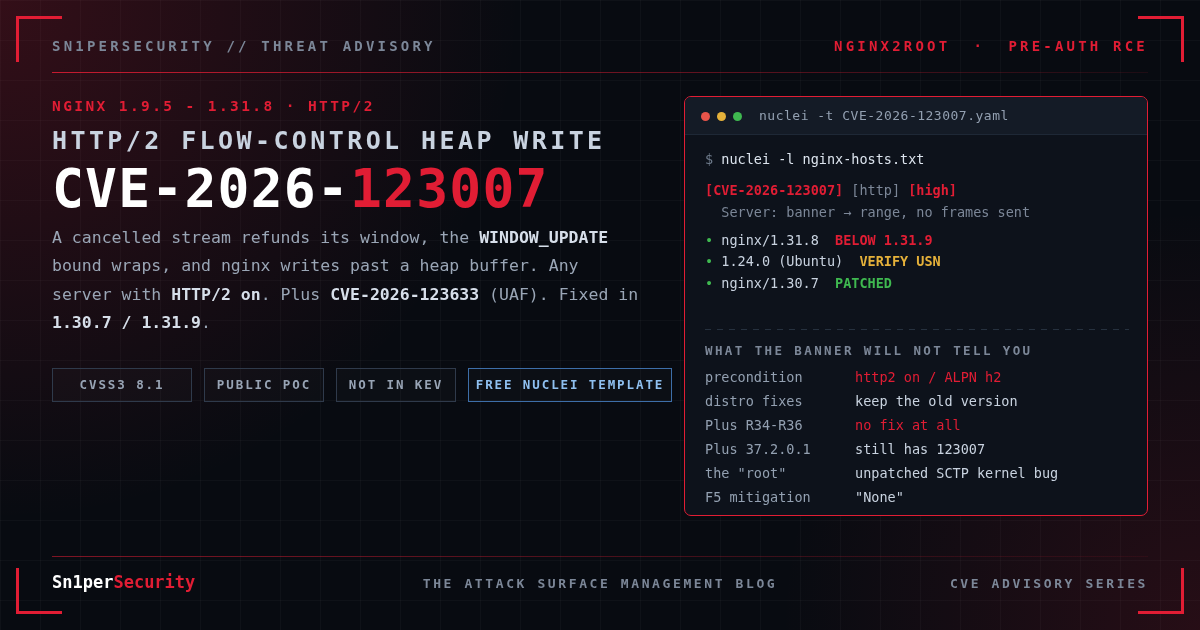

CVE-2026-123007 is a memory corruption flaw in NGINX’s HTTP/2 flow control that lets an unauthenticated attacker run code inside an nginx worker process on any server with HTTP/2 enabled. It shipped with the very first HTTP/2 release, 1.9.5, and stayed in every official build for more than ten years, until nginx 1.30.7 (stable) and 1.31.9 (mainline) fixed it on 18 November 2026 together with CVE-2026-123633, a use-after-free in the same module. The Xint research team, who reported both through HackerOne, published them as part of a five-CVE set they call nginx2root. A public proof of concept for CVE-2026-123007 is already on GitHub.
The headlines are loud and partly wrong, and it matters for what you do next. This post is three things. First, a plain-English explanation of both bugs, including the preconditions the vendor lists and most coverage leaves out. Second, a free, non-destructive Nuclei template that finds affected NGINX builds without opening a single HTTP/2 connection, and handles the distribution-backport problem that makes every naive version check wrong. Third, how to find every NGINX host across an attack surface with Sn1per, because the ones that stay vulnerable are always the ones nobody remembered.
One rule before anything else: do not try to trigger these to confirm them. Both are heap memory corruption. A failed attempt crashes worker processes on a live server, and a successful one is an intrusion. Every check here is a banner read, an ordinary TLS handshake or a configuration read.
CVE-2026-123007 and CVE-2026-123633 at a glance
- CVE-2026-123007, “Memory corruption in HTTP/2 flow control”: integer underflow leading to a heap out-of-bounds write (CWE-191 per F5, CWE-787 per Red Hat). Affects NGINX OSS 1.9.5 through 1.31.8. nginx.org severity: major.
- CVE-2026-123633, “Use-after-free in HTTP/2” (CWE-416 per F5, CWE-825 per Red Hat). Affects NGINX OSS 1.19.7 through 1.31.8. nginx.org severity: medium.
- CVSS: F5, the CNA, scores both 8.1 High in CVSS v3.1 (
AV:N/AC:H/PR:N/UI:N/S:U/C:H/I:H/A:H) and 9.2 Critical in CVSS v4.0. Red Hat and Ubuntu use the 8.1. NVD has not scored either. - Precondition: HTTP/2 enabled. CVE-2026-123633 also needs proxying to a backend and a worker running short of
worker_connections. - Fixed: NGINX OSS 1.30.7 and 1.31.9. NGINX Plus 37.0.8.1 or 37.3.0.1 fixes both.
- Exploitation: public PoC for CVE-2026-123007; not in CISA KEV (catalog 2026.11.20); no confirmed in-the-wild use.
- Fix now: upgrade and restart. If you cannot, turn HTTP/2 off on every affected listener.
What is CVE-2026-123007?
HTTP/2 has flow control. Each side advertises a window, the number of bytes it is willing to receive, and the peer sends WINDOW_UPDATE frames to grow it. NGINX tracks how much it may still send on a connection in h2c->send_window, and checks every incoming WINDOW_UPDATE so the window never exceeds the protocol maximum.
The flaw sits in what happens when a stream is cancelled. When a stream ends with data still queued, ngx_http_v2_filter_cleanup() refunds the unsent bytes back to the connection’s send window. If the client sent a WINDOW_UPDATE while that data was queued, the refund can push the window above the maximum. The bound check in ngx_http_v2_state_window_update() subtracts the window from the maximum, and with the window now larger, that unsigned subtraction wraps to a huge number. The check passes things it should reject, the buffer sizing in ngx_http_v2_send_chain() goes wrong, and nginx writes past the end of a heap buffer.
The fix, nginx commit b89c410, adds a send_queued counter so the WINDOW_UPDATE check accounts for data still in flight. Wiz reports reaching code execution on the official 1.31.7 and 1.31.8 images serving ordinary static files with no backend, which is what makes this one broad: any HTTP/2 listener qualifies.
What is CVE-2026-123633?
The second bug is about connection bookkeeping. NGINX keeps a queue of “reusable” connections it is allowed to close when it runs out of free connection slots. A connection that had received only part of an HTTP/2 HEADERS frame could sit in that queue, and ngx_http_v2_create_stream() did not clear the reusable flag once a real stream existed. If the worker then ran short of connections while opening a connection to an upstream, ngx_drain_connections() could pick that live connection, close it and free its memory further up the call stack. That is a use-after-free.
The fix, commit 0c87dd1, clears the flag when the stream is created. F5 lists the preconditions plainly: HTTP/2 on client connections, proxying requests to a backend, and the worker running low on worker_connections. Xint’s working exploit also used a second, HTTP/1 port to use up connection slots, and needed nginx to be able to open a TCP connection to the attacker. That is a much narrower population than CVE-2026-123007.
nginx2root is five CVEs, and the release fixed ten
Xint uses the nginx2root name for five independent nginx bugs, each with its own configuration requirement. Only two of them are HTTP/2 bugs, and only those two are blocked by turning HTTP/2 off.
| CVE | Configuration it needs | First affected | Blocked by disabling HTTP/2? |
|---|---|---|---|
| CVE-2026-123007 | HTTP/2 enabled | 1.9.5 | Yes |
| CVE-2026-123633 | HTTP/2 plus proxying to an upstream | 1.19.7 | Yes |
| CVE-2026-123634 | resolver, a variable proxy_pass and mirror |
0.6.18 (nginx.org) | No |
| CVE-2026-121810 | HTTP/3 plus proxying to an upstream | 1.25.0 | No |
| CVE-2026-113425 | Mail proxy | 0.5.33 | No |
The same nginx release fixed five more: CVE-2026-118899 (TLS 1.3 request body loop), CVE-2026-125283 (alias with try_files), CVE-2026-120967 (stream SNI client certificate bypass), CVE-2026-123640 (ssl_preread) and CVE-2026-120993 (PROXY protocol v2, mainline 1.31.4 to 1.31.8 only). That is ten CVEs in 1.31.9 and nine in 1.30.7. “We turned off HTTP/2” is the right holding action for the two bugs in this post, and the wrong answer to the release.
And the “root” in the name needs a footnote. The nginx bugs give code execution as the worker process, which normally runs unprivileged. Xint reached root by chaining a separate, still-unpatched Linux kernel bug in the SCTP subsystem, which also escaped a Docker container. More on that in the remediation section, because it is the part of this story that does not have a patch yet.
The scoring is a mess, and so is some of the advice
If you read only one number, you will read the wrong one. Here is what each source actually says:
| Source | CVE-2026-123007 | CVE-2026-123633 |
|---|---|---|
| nginx.org advisory | major | medium |
| F5 (CNA), CVSS v3.1 | 8.1 High | 8.1 High |
| F5 (CNA), CVSS v4.0 | 9.2 Critical | 9.2 Critical |
| Red Hat | 8.1, Critical | 8.1, Critical |
| Ubuntu | 8.1, priority high | 8.1, priority high |
| NVD | not scored | not scored |
F5 states code execution is possible “on systems with ASLR disabled or when the attacker can bypass ASLR”. The researchers showed that the bypass is achievable. So “critical” is fair for CVE-2026-123007 on a busy HTTP/2 edge, and “medium” is fair for CVE-2026-123633 on a static site with no proxying.
Two other corrections, because cloud-provider notices are circulating with them:
- NGINX Plus R33 is not in F5’s affected table. F5’s K-articles (K000163926 and K000163928) list R34, R35 and R36 as vulnerable with no fix, and the 37.x line as fixable. R33 appears only in the machine-readable CVE record. Treat any pre-37 Plus as unfixable and plan the move to 37.0.8.1 or 37.3.0.1.
- F5’s own advisories say “Mitigation: None”. The
http2 off;workaround comes from the researchers and Red Hat, not the vendor. It does remove the attack path for these two CVEs, but it is a holding action, not a fix.
One more Plus trap: 37.0.7.1 and 37.2.0.1 fix CVE-2026-123633 but are still vulnerable to CVE-2026-123007. If someone patched Plus on the first advisory, check which build they landed on.
Affected and fixed versions
| Product | Affected | Fixed |
|---|---|---|
| NGINX OSS mainline | 1.31.0 – 1.31.8 | 1.31.9 |
| NGINX OSS stable | up to 1.30.6 | 1.30.7 |
| NGINX OSS 1.28.x legacy | 1.28.3 and earlier | none, move to 1.30.7 |
| NGINX OSS before 1.19.7 | 1.9.5 – 1.19.6 (CVE-2026-123007 only, per upstream) | 1.30.7 |
| NGINX Plus 37.0.x | 37.0.0 – 37.0.7.1 | 37.0.8.1 |
| NGINX Plus 37.1 – 37.2 | 37.1.0 – 37.2.0.1 | 37.3.0.1 |
| NGINX Plus R34 – R36 | all | none |
F5 also lists affected builds of NGINX Ingress Controller, NGINX Gateway Fabric, NGINX Instance Manager and the F5 WAF and DoS modules for NGINX. If you run any of those, read K000163926 and K000163928 directly.
Distribution packages are where version scanners fall apart. Every distribution fix keeps the old upstream version number:
| Distribution | Fixed package | nginx -v still says |
|---|---|---|
| Ubuntu 24.04 noble | 1.24.0-2ubuntu7.20 (USN-9159-1) | 1.24.0 |
| Ubuntu 22.04 jammy | 1.18.0-6ubuntu14.23 (USN-9159-1) | 1.18.0 |
| Debian 12 bookworm | 1.22.1-9+deb12u11 (DLA-4918-1) | 1.22.1 |
| Debian 13 trixie | 1.26.3-3+deb13u11 (DSA-6642-1) | 1.26.3 |
| Debian sid | 1.30.6-4 | 1.30.6 |
| RHEL 10 | nginx-1.26.3-16.el10_3.3 (RHSA-2026:100744) | 1.26.3 |
| RHEL 9 | nginx-1.20.1-32.el9_9.2, plus 1.24 and 1.26 module streams | 1.20.1 / 1.24 / 1.26 |
| RHEL 8 | nginx:1.24 module stream (RHSA-2026:100747) | 1.24 |
A scanner that compares the Server header to 1.30.7 flags every one of those patched hosts. There is also a disagreement at the bottom of the range. Ubuntu, from code reading, considers its 1.18.0 builds reachable for CVE-2026-123633 over cleartext listen ... http2, below the 1.19.7 floor that upstream and F5 publish, and patched them on that basis. If you run old builds with cleartext HTTP/2, defend for Ubuntu’s reading.
And as always, an installed package is not a patched process. NGINX keeps old workers alive while they drain connections, so reload, then confirm the old workers have exited. For containers, redeploy from the patched image and check the running digest, not the tag.
How the exploit chain works
The shape of a CVE-2026-123007 attack, with the parts that matter removed:
TLS handshake, ALPN "h2"
HTTP/2 connection preface + SETTINGS
HEADERS  (open a stream whose response will be queued)    [REDACTED]
WINDOW_UPDATE frames timed against the queued DATA       [REDACTED]
RST_STREAM  (cancel, triggering the send-window refund)   [REDACTED]
... repeated until the window passes the protocol maximum
[REDACTED: the frame sequence that turns the wrapped bound into a controlled write]
Nothing in that sequence is an HTTP request in the sense your access log understands. WINDOW_UPDATE and RST_STREAM are control frames. They are not logged as requests, and TLS hides them from any network sensor that does not terminate TLS.
The public proof of concept is not a one-shot. The Rapid7 researcher’s write-up says it needs on the order of 128 GB of HTTP/2 traffic on one connection, cannot work below roughly 300 Mbit/s because of nginx’s default one-hour connection lifetime, and depends on a specific glibc memory copy routine on x86-64 CPUs with AVX-512. It yields worker privileges only. Those are real constraints on that particular exploit, not on the bug, and Xint and Wiz both report their own working chains that they have not released.
We are deliberately not publishing a working exploit, the frame timing or the heap layout here. That is consistent with every advisory in this series, including our earlier NGINX write-up, NGINX Rift, CVE-2026-42945.
Am I affected? Quick manual checks
On the host, four questions, in order. Is the version in range, is the HTTP/2 module built in, is HTTP/2 enabled, and is it reachable:
nginx -v 2>&1
nginx -V 2>&1 | grep -q -- '--with-http_v2_module' && echo HTTP2_MODULE=present || echo HTTP2_MODULE=absent
sudo nginx -T 2>&1 | sed 's/#.*//' | grep -nE 'listen[[:space:]].*http2|^[[:space:]]*http2[[:space:]]+on[[:space:]]*;'
dpkg -l 'nginx*' | awk '/^ii/{print $2, $3}'    # Debian / Ubuntu: compare with the table above
rpm -q nginx                                       # RHEL family
Run nginx -T as root and make sure it ends with “test is successful”. If the config test fails, it prints nothing useful, and an empty grep then looks exactly like “HTTP/2 is off”. We hit that ourselves while testing the local check below inside the official image, where the error log is a symlink to /dev/stderr.
For CVE-2026-123633, also check whether this server proxies to a backend:
sudo nginx -T 2>&1 | sed 's/#.*//' | grep -nE '^\s*(proxy_pass|grpc_pass|fastcgi_pass|uwsgi_pass)\s'
From the outside, the version comes from the Server header if server_tokens is on, and HTTP/2 reachability comes from TLS ALPN:
curl -sI https://example.com | grep -i '^server:'
openssl s_client -connect example.com:443 -servername example.com -alpn h2 </dev/null 2>&1 | grep -F 'ALPN protocol: h2'
The ALPN line printing means HTTP/2 is reachable. It says nothing about whether the build is patched. The Server header says nothing about backports. Each answers one half of the question.
Nuclei detection template for CVE-2026-123007 and CVE-2026-123633
The template sends one plain HTTP GET and reads the Server header. It opens no HTTP/2 connection and sends no frames. Its matchers are mutually exclusive, so each host gives exactly one line, and the matcher name tells you which range applied, including two that exist only to stop distribution hosts from being reported as confirmed findings.
id: CVE-2026-123007

info:
  name: NGINX HTTP/2 - Flow-Control Memory Corruption and Use-After-Free (CVE-2026-123007, CVE-2026-123633) [nginx2root]
  author: xer0dayz
  severity: high
  description: |
    NGINX OSS before 1.30.7 / 1.31.9 is affected by CVE-2026-123007
    (1.9.5-1.31.8) and CVE-2026-123633 (1.19.7-1.31.8) in ngx_http_v2_module.
    Both need HTTP/2 enabled. NON-DESTRUCTIVE: one GET, reads Server, sends no
    HTTP/2 frames. Distribution fixes keep the old version string, so Ubuntu
    banners and known distro base versions get their own verify-package
    matchers instead of a vulnerable verdict.
  remediation: |
    Upgrade to 1.30.7 or 1.31.9 (or the distro fixed package) and restart.
    NGINX Plus: 37.0.8.1 or 37.3.0.1. Interim: http2 off; plus remove http2
    from listen directives.
  reference:
    - https://nginx.org/en/security_advisories.html
    - https://my.f5.com/manage/s/article/K000163926
    - https://my.f5.com/manage/s/article/K000163928
    - https://nvd.nist.gov/vuln/detail/CVE-2026-123007
  classification:
    cvss-metrics: CVSS:3.1/AV:N/AC:H/PR:N/UI:N/S:U/C:H/I:H/A:H
    cvss-score: 8.1
    cve-id: CVE-2026-123007,CVE-2026-123633
    cwe-id: CWE-416,CWE-191,CWE-787
  metadata:
    verified: false
    max-request: 1
    vendor: f5
    product: nginx
    shodan-query: "Server: nginx/"
  tags: cve,cve2026,nginx,nginx2root,http2,rce,use-after-free,memory-corruption,patch-gap

http:
  - method: GET
    path:
      - "{{BaseURL}}"

    matchers-condition: or
    matchers:
      - type: dsl
        name: nginx-ubuntu-package-verify-usn
        dsl:
          - "regex('^nginx/[0-9]', srv) && contains(srv, '(Ubuntu)')"

      - type: dsl
        name: nginx-distro-base-version-verify-package
        dsl:
          - "!contains(srv, '(Ubuntu)') && regex('^nginx/(1\\.18\\.0|1\\.20\\.1|1\\.22\\.1|1\\.24\\.0|1\\.26\\.3|1\\.30\\.6)([^0-9.]|$)', srv)"

      - type: dsl
        name: nginx-mainline-below-1.31.9
        dsl:
          - "!contains(srv, '(Ubuntu)') && compare_versions(replace_regex(srv, '^nginx/([0-9]+\\.[0-9]+\\.[0-9]+).*$', '$1'), '>= 1.31.0', '< 1.31.9')"

      - type: dsl
        name: nginx-both-cves-below-1.30.7
        dsl:
          - "!contains(srv, '(Ubuntu)') && !regex('^nginx/(1\\.18\\.0|1\\.20\\.1|1\\.22\\.1|1\\.24\\.0|1\\.26\\.3|1\\.30\\.6)([^0-9.]|$)', srv) && compare_versions(replace_regex(srv, '^nginx/([0-9]+\\.[0-9]+\\.[0-9]+).*$', '$1'), '>= 1.19.7', '< 1.31.0') && compare_versions(replace_regex(srv, '^nginx/([0-9]+\\.[0-9]+\\.[0-9]+).*$', '$1'), '< 1.30.7')"

      - type: dsl
        name: nginx-cve-2026-123007-only-1.9.5-to-1.19.6
        dsl:
          - "!contains(srv, '(Ubuntu)') && !regex('^nginx/(1\\.18\\.0|1\\.20\\.1|1\\.22\\.1|1\\.24\\.0|1\\.26\\.3|1\\.30\\.6)([^0-9.]|$)', srv) && compare_versions(replace_regex(srv, '^nginx/([0-9]+\\.[0-9]+\\.[0-9]+).*$', '$1'), '>= 1.9.5', '< 1.19.7')"

    extractors:
      - type: kval
        name: srv
        part: header
        internal: true
        kval:
          - server

      - type: kval
        name: nginx_server_banner
        part: header
        kval:
          - server
Save it as CVE-2026-123007.yaml and run it:
nuclei -t CVE-2026-123007.yaml -validate
nuclei -t CVE-2026-123007.yaml -u https://example.com
nuclei -t CVE-2026-123007.yaml -l nginx-hosts.txt -o nginx2root.txt < /dev/null
A match looks like this:
[CVE-2026-123007:nginx-mainline-below-1.31.9] [http] [high] https://example.com ["nginx/1.31.8"]
The < /dev/null matters. Nuclei reads targets from stdin whenever stdin is not a terminal, so inside a shell loop or a cron job it can sit waiting on input that never closes. That cost us a stalled test run while building this package.
The blind spots, stated plainly. server_tokens off removes the version, and silence then means unknown, not clean. Distribution builds can never be confirmed from the banner, which is why those land in a verify-package matcher. The template cannot see whether HTTP/2 is on, which is the precondition for both CVEs. And NGINX Plus reports an OSS-style version, so judge Plus by its own build number. We built the template against a 22-banner matrix (every range edge, Ubuntu and distro base versions, a near-miss version, a stripped banner) and against official nginx:1.30.6, 1.30.7, 1.31.8 and 1.31.9 containers with HTTP/2 on and off. It ships verified: false because it has not been run against every distribution’s packages.
One small authoring note for anyone extending it: in our testing, a DSL regex() with an escaped parenthesis, \(Ubuntu\), silently never matched, while contains(srv, '(Ubuntu)') did. If a matcher you expect to fire stays quiet, test it against a mock before trusting the silence.
Closing the HTTP/2 blind spot: ALPN and a local check
The detection script in this advisory package combines the two halves. In remote mode it reads the Server header like the template and, for HTTPS targets, completes one ordinary TLS handshake offering h2 to learn whether HTTP/2 is negotiated. It sends no HTTP/2 frames. An in-range nginx.org build with h2 negotiated is reported AFFECTED; the same build without h2 is a patch gap.
In local mode it runs nginx -V and nginx -T and the package manager, and reports the version, whether the HTTP/2 module is built in, whether HTTP/2 is enabled, whether the server proxies to a backend, and whether the package is a distribution build that needs a USN, DSA or RHSA check. With --root /proc/<pid>/root it enters a running container’s mount and PID namespaces, which is how we tested it against the official images.
python3 cve-2026-123007-detect.py remote -f nginx-hosts.txt --timeout 8
sudo python3 cve-2026-123007-detect.py local
sudo python3 cve-2026-123007-detect.py local --root /proc/$(docker inspect -f '{{.State.Pid}}' my-nginx)/root
Exit code 1 means an in-range build with HTTP/2 on. Exit code 2 means verify or patch gap. Exit code 0 means fixed, or a build without HTTP/2.
Detecting nginx2root across your attack surface with Sn1per
NGINX is not one server in most estates. It is the edge proxy, the ingress controller, the container base image three teams copied, the appliance with an embedded web UI, and the reverse proxy someone stood up for a demo in 2021. This is a discovery problem before it is a scanning problem.
Drop the template into Sn1per’s curated set and it runs against every HTTP service Sn1per finds:
sudo cp CVE-2026-123007.yaml /usr/share/sniper/templates/nuclei/server/

sudo sniper -t example.com -m recon -w nginx2root
sudo sniper -t example.com -m web   -w nginx2root
For a whole estate, let discovery feed the same set:
sudo sniper -t 10.0.0.0/24 -m discover -w nginx2root
sudo sniper -t example.com -m airstrike -w nginx2root
Professional and Enterprise expose findings through the JSON API:
curl -sk -H "X-API-Key: $SN1PER_API_KEY" \
  "https://sn1per.local/pro/api.php?action=vulnerabilities&workspace=nginx2root" \
  | jq '.[] | select(.name | test("CVE-2026-123007"))'
Then run the detection script’s remote mode over the matched hosts to split “in range and HTTP/2 on” from “in range, HTTP/2 off”. That ordering, broad passive sweep first and targeted ALPN check second, keeps the noisy part small. And the self-hosted point applies more than usual here: a list of every edge server with an unpatched HTTP/2 stack is the most useful document an attacker could hope to find, so keep it on your own infrastructure. That is what external attack surface management with Sn1per is built for.
Which Sn1per edition fits
| Capability | Community | Professional 2026 | Enterprise |
|---|---|---|---|
| Run the nginx2root template | Yes | Yes | Yes |
| Curated Nuclei set maintained for you | Partial | Yes | Yes |
| Workspaces and scan history | Basic | Yes | Yes |
| Web UI with asset risk ranking | No | Yes | Yes |
| JSON API for finding export | No | Yes | Yes |
| Scheduled recurring surface sweeps | No | Limited | Yes |
| Multi-user, delegated workspaces | No | No | Yes |
A one-off sweep with Community and the template answers “where is NGINX on our perimeter and which builds are in range”. The recurring version is what catches the ingress controller that gets redeployed from an old image next month. That is the case for continuous attack surface testing over a spreadsheet.
Remediation and mitigation
- Upgrade to NGINX 1.30.7 or 1.31.9, or your distribution’s fixed package. Use USN-9159-1, DLA-4918-1, DSA-6642-1 or the RHSA-2026:100744 to 100748 set, and check the full package version, not
nginx -v. - Reload and confirm the old workers are gone. For containers and Kubernetes, roll the deployment from the patched image and verify the running image digest.
- NGINX Plus: go to 37.0.8.1 or 37.3.0.1. 37.0.7.1 and 37.2.0.1 still carry CVE-2026-123007. R34 to R36 have no fix.
- If you cannot patch today, turn HTTP/2 off. On 1.25.1 and later set
http2 off;in every server block that shares the address and port, and removehttp2fromlistendirectives. On 1.9.5 to 1.25.0, removing thelistenparameter is the only option. Then confirm with theopenssl s_client -alpn h2check that ALPN no longer offersh2. This blocks these two CVEs only; it does nothing for the other eight in the release, and it breaks native gRPC. - Block the SCTP kernel module on hosts that do not use it. Xint’s root escalation and container escape use an unpatched Linux SCTP bug. Until a kernel fix ships, put
install sctp /bin/falsein a file under/etc/modprobe.d/. It does not unload a module that is already loaded and does not affect SCTP built into the kernel, so checklsmod | grep sctpas well. - Do not rely on access logs to tell you whether you were hit. The trigger frames are not logged as requests. Xint suggests looking for a single client holding one long TLS connection open for minutes while
bytes_receivedgrows fast and nginx sends little back (ss -tinp state established '( sport = :443 )', sampled twice), many short TLS connections from the same address, worker processes exiting on signals in the error log, and child processes started by nginx workers. An nginx worker should never spawn a shell.
Frequently asked questions
What is nginx2root? nginx2root is the name the Xint research team gave to five independent NGINX vulnerabilities fixed on 18 November 2026: CVE-2026-123007, CVE-2026-123634, CVE-2026-123633, CVE-2026-121810 and CVE-2026-113425. The most impactful is CVE-2026-123007, an HTTP/2 flow-control memory corruption that allows unauthenticated code execution as the nginx worker on any server with HTTP/2 enabled. The “root” comes from chaining it with a separate, unpatched Linux kernel SCTP bug, not from nginx itself.
Which NGINX versions are affected by CVE-2026-123007? NGINX OSS 1.9.5 through 1.31.8, which is every official release since HTTP/2 support was added. It is fixed in 1.30.7 (stable) and 1.31.9 (mainline). CVE-2026-123633 affects 1.19.7 through 1.31.8 with the same fixes. The 1.28.x legacy branch has no fix. NGINX Plus is fixed in 37.0.8.1 and 37.3.0.1, while R34 to R36 have no fix. Distribution packages are fixed without changing the version, so Ubuntu 24.04 still reports 1.24.0 after patching.
Is CVE-2026-123007 exploited in the wild? No in-the-wild exploitation has been confirmed by any primary source, and neither CVE is in the CISA Known Exploited Vulnerabilities catalog as of version 2026.11.20. A public proof of concept for CVE-2026-123007 is on GitHub from the Rapid7 researcher who reported it, but it needs around 128 GB of HTTP/2 traffic on one connection and specific CPU and glibc conditions. Several research teams report private working exploits, so treat exposure as urgent.
Does disabling HTTP/2 fix CVE-2026-123007 and CVE-2026-123633? It removes the attack path for those two CVEs, which both live in the HTTP/2 module, but it is a temporary measure. F5’s own advisories list no mitigation, the advice comes from the researchers and Red Hat, and it does not touch the other eight CVEs fixed in the same release. On NGINX 1.25.1 and later set http2 off; in every server block on the shared address and port and remove http2 from listen directives, then confirm with an ALPN check that h2 is no longer offered.
Is the nginx2root Nuclei template safe to run in production? Yes. It sends one ordinary HTTP GET request and reads the Server response header. It never opens an HTTP/2 connection or sends any HTTP/2 frame, so it cannot trigger either vulnerability. The trade-off is that it only sees a version: a server with server_tokens off is unknown rather than clean, and distribution packages are flagged for a package check instead of being reported as vulnerable.
Closing
The lesson here is not that HTTP/2 is dangerous. It is that a bug can sit in the most reviewed web server on the internet for eleven years, and that when it surfaces, the version number you scan for is the least reliable fact you have. Distributions hide the fix behind an old number, Plus has three generations with no fix at all, and the configuration that decides exposure lives on the host. Find every NGINX instance first, sort them by what the banner can and cannot prove, and confirm the rest at the package and config level. Run the template across your whole surface today.
Primary sources, read on 21 November 2026: the nginx.org security advisories and CHANGES, F5 K000163926 and K000163928, NVD CVE-2026-123007, Ubuntu USN-9159-1, the Debian security tracker, Red Hat RHSB-2026-019, the CISA KEV catalog, and the researcher write-ups from Xint, Wiz and Rapid7.