
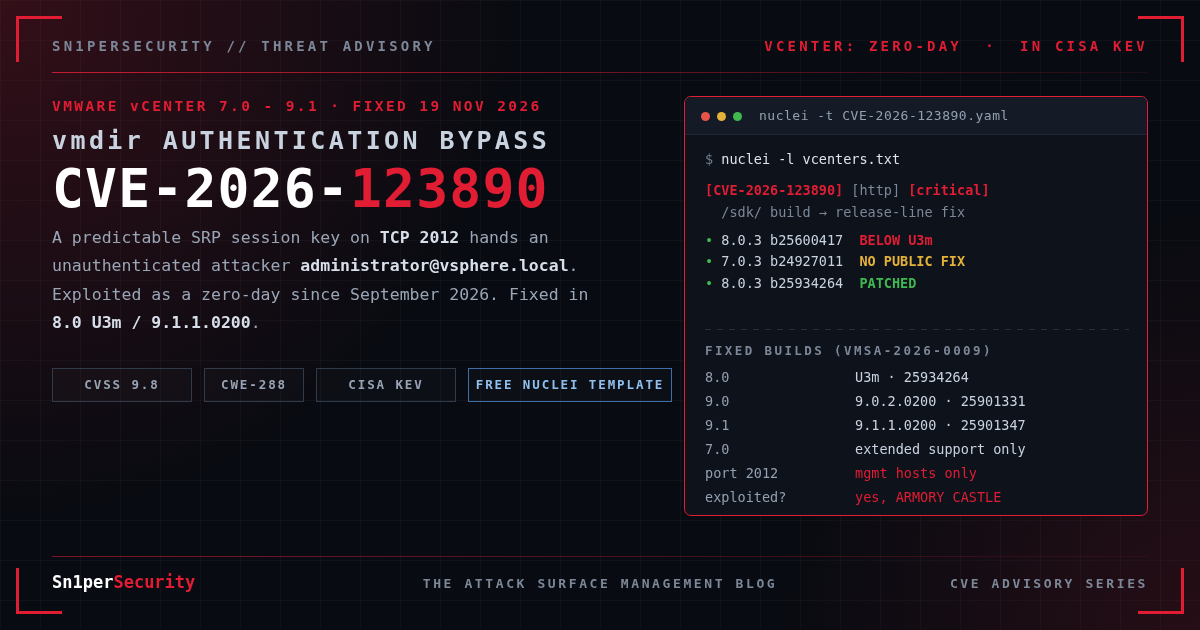

CVE-2026-123890 is an unauthenticated authentication bypass in the VMware Directory Service (vmdir) inside VMware vCenter Server. An attacker who can reach vCenter’s port 2012 can recover a Secure Remote Password session key without knowing any password and use it to act as [email protected], the most privileged account in a vSphere environment. Broadcom fixed it on 19 November 2026 in VMSA-2026-0009 with a CVSS v3.1 score of 9.8 and no workaround. CISA added it to the Known Exploited Vulnerabilities catalog the next day, because a suspected PRC-nexus espionage group had already been using it as a zero-day since early September.
This post is three things. First, a plain-English explanation of the flaw and of what the attackers did with it, drawn from the vendor advisory and the Google Threat Intelligence report rather than from news coverage. Second, a free, non-destructive Nuclei template that reads the vCenter build without logging in and tells you whether it is below the fixed build for its release line, plus a second template that tells you whether port 2012 is reachable from where you are standing. Third, how to find every vCenter across your environment with Sn1per, including the ones nobody remembers deploying. Broadcom credits Mandiant with reporting the issue, and Google Threat Intelligence Group and Mandiant published the exploitation analysis.
One rule first: do not try to reproduce this bug to “confirm” it. The exploit path ends with an attacker holding an administrator session and the vCenter identity database. Everything in this post is a build read or a port reachability check, and neither one touches the vulnerable code.
CVE-2026-123890 at a glance
- CVE / advisory: CVE-2026-123890, VMSA-2026-0009 (updated to VMSA-2026-0009.1 on 20 November 2026)
- CWE: CWE-288, authentication bypass using an alternate path or channel
- Impact: unauthenticated session as [email protected], which Google observed being used to create rogue SSO administrators, steal the vmdir database (data.mdb) and the SAML signing key, and forge admin tokens
- CVSS v3.1: 9.8 Critical,
CVSS:3.1/AV:N/AC:L/PR:N/UI:N/S:U/C:H/I:H/A:H(Broadcom as CNA; NVD status Analyzed) - Entry point: TCP 2012, the vCenter Single Sign-On DCE/RPC control interface (
rpc_srp_verifierin vmdir) - Affected: vCenter 9.1.x, 9.0.x, 8.0 and 7.0; VMware Cloud Foundation 5.x; Telco Cloud Platform 3.0 through 5.2 and Telco Cloud Infrastructure 3.0
- Fixed: vCenter 8.0 U3m (build 25934264), 9.0.2.0200 (build 25901331), 9.1.1.0200 (build 25901347), VCF 5.2.5. No public fix for 7.0.
- Exploitation: in CISA KEV since 20 November 2026 with a federal due date of 23 November 2026. Exploited as a zero-day since early September 2026 by ARMORY CASTLE (formerly UNC5221) using a Go tool Google calls BONESAW. Google reported no public proof of concept, but GitHub repositories claiming a working one appeared from 23 November 2026. We have not reviewed or run them.
- Fix now: patch to the newest vCenter build for your line, restrict port 2012 to management hosts, then hunt for prior compromise. Patching does not evict an attacker who is already in.
What is CVE-2026-123890?
vCenter’s Single Sign-On is built on the VMware Directory Service, an LDAP-style directory that stores every SSO user, group, tenant certificate and the private key vCenter uses to sign SAML tokens. That data lives in a Lightning Memory-Mapped Database file at /storage/db/vmware-vmdir/data.mdb. Besides LDAP on 389 and 636, vmdir exposes a DCE/RPC control interface on TCP 2012 that other vCenter components use to talk to it.
One of the services on that interface, rpc_srp_verifier, implements Secure Remote Password (SRP-6a) authentication. SRP is designed so that a client proves it knows a password without sending it, and both sides end up holding a shared session key. According to Google Threat Intelligence, CVE-2026-123890 is “a cryptographic logic and authorization flaw” in that service. The SRP authentication interface generates identifiers from UUIDv1 values, which are built from timestamps and are therefore predictable. That lets an unauthenticated caller recover the shared SRP session key and use it to establish an authenticated session as [email protected], without ever knowing a password.
Broadcom’s own description is shorter: “VMware vCenter contains an authentication bypass vulnerability in the VMware Directory Service.” The advisory says a malicious actor “with network access to vCenter” may exploit it. It does not name the port. Google does, and Google also names the tool, the actor and the timeline, so this post relies on both sources and says which one each fact came from.
This is not the first vmdir authentication bypass this year. CVE-2026-59309, fixed in VMSA-2026-0006 on 29 July 2026, was an LDAP bypass on 389/636. Mandiant reports that BONESAW was run in early September against a vCenter that was already patched for CVE-2026-59309, and that the recovered binary carries a build timestamp of 13 July 2026, two weeks before that earlier disclosure. Google notes that Go build metadata can be altered, but the reading is clear enough: the July patch closed a different door, and the attackers already had a second one.
There is a third vmdir bypass to know about. On 24 November 2026, Broadcom published VMSA-2026-0011, which fixes CVE-2026-123903, another critical authentication bypass in the VMware Directory Service. Broadcom says it is “a new and distinct issue” and is not related to CVE-2026-123890. It matters for patch planning, which we cover below.
Affected and fixed versions
The fixed builds below come from the VMSA-2026-0009 response matrix and Broadcom KB 326316 (vCenter build numbers). The build is the number to compare. The version string alone cannot distinguish 8.0 U3k from 8.0 U3m, because both report 8.0.3.
| vCenter line | Affected | Fixed for CVE-2026-123890 | Recommended target as of 24 Nov 2026 |
|---|---|---|---|
| 9.1.x (VCF / VVF 9.1) | below 9.1.1.0200 | 9.1.1.0200, build 25901347 | 9.1.2 (also fixes CVE-2026-123903) |
| 9.0.x (VCF / VVF 9.0) | below 9.0.2.0200 | 9.0.2.0200, build 25901331 | 9.0.2 express patch from VMSA-2026-0011 |
| 8.0 | below 8.0 U3m | 8.0 U3m, version 8.0.3.01200, build 25934264 | 8.0 U3m (Broadcom says it covers VMSA-2026-0011 too) |
| 7.0 | all | none public; extended-support customers contact Broadcom | upgrade to a supported line |
| VCF 5.x | below 5.2.5 | vCenter 8.0 U3m via async patching (KB 88287) plus SDDC Manager 5.2.5 | same |
| Telco Cloud Platform 3.0 to 5.2, Telco Cloud Infrastructure 3.0 | all | per KB 463116 | per KB 463116 |
The 7.0 contradiction. Sources disagree on vCenter 7.0, so plan for the worse case. The VMSA-2026-0009 response matrix lists 7.0 as affected, with the fix “Contact Broadcom Support if you have extended support contract.” NVD’s CPE configuration includes vCenter 7.0 as well. Broadcom’s own VMSA-2026-0009 FAQ, however, says “the advisory does not list vCenter 7.0” and tells readers to presume it is affected. Google reports that BONESAW achieves full compromise against 7.x and 8.x appliances. The practical answer is the same whichever document you read: 7.0 is vulnerable, there is no public patch, and general support ended on 2 October 2025.
There is no 8.0 U3l. The 8.0 line went from U3k (8.0.3.01000, build 25600417, 29 July 2026) straight to U3m. If your change ticket says “8.0 U3 latest” and was closed in August, you are on U3k and vulnerable.
Staged is not installed. A patch downloaded in the VAMI, or approved in Lifecycle Manager, does nothing until the update has completed and services have restarted. Confirm the running build, not the ticket.
Upgrade path gotcha. Broadcom notes that vCenter 8.0 U3m and 9.0.2.0200 created a “Back-in-Time” restriction that blocked upgrades to VCF 9.1.1. VCF 9.1.2, released on 24 November, lifts it. If you paused an upgrade to wait, you can continue.
How the exploit chain works
Google’s report describes BONESAW in enough detail to understand the chain without reproducing it. The skeleton looks like this:
TCP connect  vcenter:2012                        (vmdir DCE/RPC control interface)
DCE/RPC bind rpc_srp_verifier                    (SRP authentication interface)
SRP exchange [REDACTED - predictable UUIDv1 values let the caller recover the session key]
-> authenticated vmdir session as [email protected]
vmdirdbcp    [REDACTED - stream /storage/db/vmware-vmdir/data.mdb to the attacker]
LDAP / SOAP  create SSO administrator, assign Global Administrator
BONESAW’s csa subcommand (“create SSO admin”) takes a target vCenter, a new username and a password, and has a -check-version flag that probes the target version before running. With the administrator session in hand, the tool uses the vmdir database-copy RPC interface, vmdirdbcp, to pull the raw data.mdb. That file contains the tenant credentials and the SAML Security Token Service private signing key. With that key, a second tool Google calls SAWSNAKE forges SAML 2.0 assertions for any user, including the administrator, and Google notes that this bypasses MFA. This is a Golden SAML attack: the attacker no longer needs the bug, because they can mint valid logins for as long as that signing key stays in use.
In the intrusion Google analysed, ARMORY CASTLE did not come in from the internet. It came in through a zero-day in BeyondTrust Remote Support (CVE-2026-102764), moved to an internal Linux appliance, and ran nmap against internal subnets looking for ports 443, 2012, 389, 5480 and 9080. From there it exploited vCenter, created a local administrator named sps-<redacted>@vsphere.local, and turned on SSH through the VAMI API with a PUT /rest/appliance/access/ssh request. It then took the vCenter master crypto key and PostgreSQL password file, turned SSH back off, and moved on to ESXi hosts. There it read virtual disks directly to extract NTDS.dit and registry hives from domain controller VMs.
We are deliberately not publishing the SRP exchange, the RPC opnums, or anything that would help reproduce the key recovery. That is the same line we took in every advisory in this series, including our recent write-ups of nginx2root (CVE-2026-123007) and php2shell (CVE-2026-109618). Defenders need to know where the door is and whether it is open, not how to walk through it.
That door is now more widely known. Google’s report said no public proof of concept existed, but from 23 November 2026 GitHub repositories appeared that claim to implement the port 2012 key recovery end to end. We have not reviewed or run them and you should not either. Fake proof-of-concept repositories for fresh, high-profile CVEs are a common way to deliver malware to the people most likely to run them, and a working one would be worse. Either way, the practical effect is the same: assume exploitation is no longer limited to one espionage group, and that opportunistic scanning of port 2012 will follow.
Am I affected? Quick manual checks
Check the build from inside vCenter
The authoritative answer is the running build. In the vSphere Client it is on the vCenter Summary tab. In PowerCLI, Broadcom’s FAQ gives the variables directly:
Connect-VIServer vcenter.example.com
$global:DefaultVIServer.Version
$global:DefaultVIServer.Build
On the appliance shell, vpxd -v prints the version and build. Compare the build against the table above: an 8.0 vCenter needs at least 25934264, a 9.0 vCenter at least 25901331, and a 9.1 vCenter at least 25901347.
Check whether vCenter is vulnerable to CVE-2026-123890 without logging in
vCenter answers one SOAP call before authentication, RetrieveServiceContent, because every vSphere client needs it to learn what it is talking to. The response includes an AboutInfo block:
curl -sk https://vcenter.example.com/sdk/ -H 'Content-Type: text/xml' --data \
'<soap:Envelope xmlns:soap="http://schemas.xmlsoap.org/soap/envelope/" xmlns:xsi="http://www.w3.org/2001/XMLSchema-instance"><soap:Body><RetrieveServiceContent xmlns="urn:internalvim25"><_this xsi:type="ManagedObjectReference" type="ServiceInstance">ServiceInstance</_this></RetrieveServiceContent></soap:Body></soap:Envelope>' \
| grep -oE '<(fullName|version|build|apiType)>[^<]*'
A vulnerable 8.0 U3k vCenter returns something like fullName>VMware vCenter Server 8.0.3 build-25600417, build>25600417 and apiType>VirtualCenter. Two cautions. First, check apiType. ESXi hosts answer the same call with HostAgent, and ESXi 8.0 U3m is build 25926933, which is lower than the vCenter 8.0 U3m build. If you compare builds without checking the product, you will report every patched ESXi host as a vulnerable vCenter. Second, this call tells you the build and nothing about whether someone has already used the bug. That needs the hunting steps further down.
What is port 2012 on vCenter, and should it be reachable?
Port 2012 is the vmdir DCE/RPC control interface for vCenter Single Sign-On. Other vCenter components and linked vCenters use it. Administrators’ laptops do not need it, user networks do not need it, and the internet never does. Check it from each network zone that matters, not only from outside:
nmap -Pn -p 2012 --open vcenter.example.com
An open port is not a vulnerable build, and a closed port is not a patch. But in the one intrusion Google documented, 2012 was reached from an internal appliance. Treat “reachable from somewhere an attacker could plausibly land” as the real exposure question.
Nuclei detection template for CVE-2026-123890
Two templates. The first reads the build through /sdk/ and flags anything below the fixed build for its release line. The second checks whether a DCE/RPC listener answers on TCP 2012. Both are read-only.
id: CVE-2026-123890

info:
  name: VMware vCenter Server - vmdir Authentication Bypass (CVE-2026-123890)
  author: xer0dayz
  severity: critical
  description: |
    VMware vCenter Server contains an authentication bypass in the VMware Directory
    Service (vmdir): an unauthenticated SRP-6a session-key disclosure in the
    rpc_srp_verifier DCE/RPC interface on TCP 2012 that yields [email protected].
    Exploited as a zero-day since early September 2026 and listed in CISA KEV.

    This template is NON-DESTRUCTIVE: it sends one unauthenticated SOAP
    RetrieveServiceContent request to /sdk (the same call every vSphere client makes
    before login), confirms apiType is VirtualCenter (ESXi hosts are ignored), extracts
    the version and build, and flags builds below the fixed build for each release line.
    It sends nothing to TCP 2012 and no SRP or RPC traffic.
  remediation: |
    Upgrade to vCenter 8.0 U3m (build 25934264), 9.0.2.0200 (build 25901331) or
    9.1.1.0200 (build 25901347); VCF 5.x via 8.0 U3m and SDDC Manager 5.2.5. 9.1.x should
    go to 9.1.2 and 9.0.x to the 9.0.2 express patch (VMSA-2026-0011, CVE-2026-123903).
    No public fix for 7.0. Restrict TCP 2012, then hunt for prior compromise.
  reference:
    - https://support.broadcom.com/web/ecx/support-content-notification/-/external/content/SecurityAdvisories/0/39495
    - https://knowledge.broadcom.com/external/article/326316/build-numbers-and-versions-of-vmware-vce.html
    - https://cloud.google.com/blog/topics/threat-intelligence/armory-castle-exploits-vsphere
    - https://nvd.nist.gov/vuln/detail/CVE-2026-123890
  classification:
    cvss-metrics: CVSS:3.1/AV:N/AC:L/PR:N/UI:N/S:U/C:H/I:H/A:H
    cvss-score: 9.8
    cve-id: CVE-2026-123890
    cwe-id: CWE-288
  metadata:
    verified: false
    max-request: 1
    vendor: vmware
    product: vcenter_server
    shodan-query: http.title:"ID_VC_Welcome"
  tags: cve,cve2026,vmware,vcenter,vmdir,auth-bypass,kev,passive

http:
  - raw:
      - |
        POST /sdk/ HTTP/1.1
        Host: {{Hostname}}
        Content-Type: text/xml; charset=utf-8

        <?xml version="1.0" encoding="UTF-8"?>
        <soap:Envelope xmlns:soap="http://schemas.xmlsoap.org/soap/envelope/" xmlns:xsd="http://www.w3.org/2001/XMLSchema" xmlns:xsi="http://www.w3.org/2001/XMLSchema-instance">
           <soap:Header>
              <operationID>00000001-00000001</operationID>
           </soap:Header>
           <soap:Body>
              <RetrieveServiceContent xmlns="urn:internalvim25">
                 <_this xsi:type="ManagedObjectReference" type="ServiceInstance">ServiceInstance</_this>
              </RetrieveServiceContent>
           </soap:Body>
        </soap:Envelope>

    matchers-condition: or
    matchers:
      - type: dsl
        name: vcenter-9.1-below-9.1.1.0200
        dsl:
          - "api_type == 'VirtualCenter' && compare_versions(version, '>= 9.1', '< 9.2') && compare_versions(build, '< 25901347')"

      - type: dsl
        name: vcenter-9.0-below-9.0.2.0200
        dsl:
          - "api_type == 'VirtualCenter' && compare_versions(version, '>= 9.0', '< 9.1') && compare_versions(build, '< 25901331')"

      - type: dsl
        name: vcenter-8.0-below-8.0u3m
        dsl:
          - "api_type == 'VirtualCenter' && compare_versions(version, '>= 8.0', '< 8.1') && compare_versions(build, '< 25934264')"

      - type: dsl
        name: vcenter-7.0-no-public-fix
        dsl:
          - "api_type == 'VirtualCenter' && compare_versions(version, '>= 7.0', '< 7.1')"

      - type: dsl
        name: vcenter-6.x-end-of-support-presumed-affected
        dsl:
          - "api_type == 'VirtualCenter' && compare_versions(version, '>= 6.0', '< 7.0')"

    extractors:
      - type: regex
        name: api_type
        internal: true
        part: body
        group: 1
        regex:
          - '<apiType>([A-Za-z]+)</apiType>'

      - type: regex
        name: version
        internal: true
        part: body
        group: 1
        regex:
          - '<version>([0-9]+\.[0-9]+(?:\.[0-9]+)?)</version>'

      - type: regex
        name: build
        internal: true
        part: body
        group: 1
        regex:
          - '<build>([0-9]+)</build>'

      - type: regex
        name: vcenter_full_name
        part: body
        group: 1
        regex:
          - '<fullName>(VMware vCenter Server [^<]+)</fullName>'
The companion port-2012 template, CVE-2026-123890-vmdir-rpc-2012.yaml, opens one TCP connection to 2012 and sends a single standard DCE/RPC bind for the generic Endpoint Mapper interface. It never binds the vmdir SRP interface and never sends a request. Any DCE/RPC bind_ack or bind_nak means a listener answers there. The full file is in the downloadable package.
Save both files and run them:
nuclei -t CVE-2026-123890.yaml -l vcenters.txt
nuclei -t CVE-2026-123890-vmdir-rpc-2012.yaml -l vcenter-hosts.txt
A match looks like this. The matcher name tells you the release line and the fix you need, and the extracted value is the running build:
[CVE-2026-123890:vcenter-8.0-below-8.0u3m] [http] [critical] https://vc01.example.com/sdk/ ["VMware vCenter Server 8.0.3 build-25600417"]
[CVE-2026-123890:vcenter-7.0-no-public-fix] [http] [critical] https://vc-legacy.example.com/sdk/ ["VMware vCenter Server 7.0.3 build-24927011"]
[CVE-2026-123890-vmdir-rpc-2012:vmdir-dcerpc-2012-reachable] [tcp] [high] vc01.example.com:2012 ["05000c03"]
We tested the build template against a mock that serves the real AboutInfo structure. The 21 cases covered every release-line boundary (fixed build minus one, the fixed build, later builds), a two-part version string, 7.0, 6.7, three ESXi profiles including ESXi 8.0 U3m, and a non-VMware server. Both templates validate cleanly on nuclei v3.11.1. We have not run them against a production vCenter, so the metadata says verified: false.
Every version-based template has blind spots, and these two have three:
- A build number is not proof of state. It tells you what vCenter says it is running. It cannot tell you whether an attacker was in before you patched. A clean result after September 2026 still needs the hunting steps below.
- Silence means unknown, not clean. If
/sdk/sits behind a reverse proxy, a WAF or an allow-list, the template gets noAboutInfoand reports nothing. Check those hosts from inside, or with PowerCLI. - The port template sees reachability from the scanner only. A closed 2012 from your scanner says nothing about 2012 from the backup server, the jump host or the Linux appliance that ARMORY CASTLE used. Run it from each zone.
Detecting CVE-2026-123890 across your attack surface with Sn1per
The vCenter that gets you breached is rarely the one in the CMDB. It is the lab vCenter from a 2023 proof of concept, the VCF management domain that an MSP still runs, the 7.0 appliance that was “being decommissioned”, or the one behind a NAT rule somebody forgot. So finding vCenters is the first problem and checking their builds is the second. Sn1per handles both: discovery modes find the hosts and their ports, and the curated Nuclei set runs the checks against everything it found.
# discover hosts, ports and services, including 443 and 2012
sniper -t example.com -m recon -w vcenter-123890

# run the web checks, including the curated Nuclei set, against every HTTP(S) port found
sniper -t example.com -m web -w vcenter-123890

# internal ranges: sweep the management networks where vCenter actually lives
sniper -f mgmt-subnets.txt -m airstrike -w vcenter-123890-internal
The port-2012 template is a network template, and Sn1per’s normal-mode network Nuclei pass runs the curated TCP templates against each bare target. That pass picks it up without any extra wiring. Pull the findings out for ticketing with the Professional JSON API:
curl -sk -H "X-API-Key: $SN1PER_API_KEY" \
  "https://sn1per.local/pro/api.php?action=vulnerabilities&workspace=vcenter-123890" \
  | jq '.[] | select(.name | test("CVE-2026-123890"))'
There is also a self-hosting argument here. A list of every vCenter you own, with its build number, the ones still on 7.0, and which zones can reach port 2012, is exactly the reconnaissance ARMORY CASTLE did by hand with nmap. That is not data you want in someone else’s cloud. Sn1per runs on your infrastructure, which is what external attack surface management with Sn1per means in practice.
Which Sn1per edition fits
| Capability | Community | Professional 2026 | Enterprise |
|---|---|---|---|
| Run the CVE-2026-123890 templates | Yes | Yes | Yes |
| Curated Nuclei set maintained for you | Partial | Yes | Yes |
| Workspaces and scan history | Basic | Yes | Yes |
| Web UI with asset risk ranking | No | Yes | Yes |
| JSON API for finding export | No | Yes | Yes |
| Scheduled recurring surface sweeps | No | Limited | Yes |
| Multi-user, delegated workspaces | No | No | Yes |
To answer “which of our vCenters are below the fixed build today”, Community plus the templates is enough. The recurring question matters more. Broadcom has now shipped three vmdir authentication bypasses in four months (CVE-2026-59309 in July, CVE-2026-123890 and CVE-2026-123903 in November), and the build you verified last week may already be one advisory behind. Scheduled sweeps and scan history turn that into a trend you can watch, which is the case for continuous attack surface testing over one-off scans.
Remediation and mitigation
- Patch to the newest build for your line, not just the minimum. For CVE-2026-123890 alone the floors are 8.0 U3m, 9.0.2.0200 and 9.1.1.0200. Because VMSA-2026-0011 fixes a second vmdir bypass, 9.1.x should go to 9.1.2 and 9.0.x to the 9.0.2 express patch. 8.0 U3m already covers both, according to Broadcom. VCF 5.x applies vCenter 8.0 U3m through the asynchronous patching process in KB 88287 and updates SDDC Manager to 5.2.5. Broadcom says updating vCenter does not interrupt running workloads.
- Treat 7.0 as unpatchable unless you hold extended support. Request the fix through your extended-support channel or upgrade. Until then, the 2012 restriction below is the only control between that appliance and an administrator session.
- Restrict TCP 2012 at the network and on the appliance. Only vCenter peers and privileged management workstations should reach it. Google’s guidance is a kernel-level iptables DROP on 2012 for anything not allow-listed, using Mandiant’s VCSA Hardening & Logging Tool. The VAMI firewall is coarse, logs nothing, and anyone with VAMI access can switch it off. Apply the same allow-listing to 443, 5480 and 22, and add an egress policy, because the backdoors Google describes talk out over HTTPS.
- Hunt for prior compromise, especially if 2012 was reachable from anywhere an attacker could land. List every SSO user and group member with administrator rights, and investigate any account you did not create, especially names like
sps-*@vsphere.local. Review VAMI and API logs forPUT /rest/appliance/access/ssh, because SSH being switched on and then off again is the pattern Google saw. Look for Google’s file indicators:ActiveSer.jspandu.jspwebshells,/tmp/123,/tmp/sss,/tmp/dbr,/usr/bin/vmtoolscs, and, on internal Linux hosts that could reach vCenter, a SUID bit on/bin/envor an SSH banner ofSSH-2.0-pulsesecure_23345. The report also publishes YARA rules for BONESAW, SAWSNAKE, BEARBONES and LAZYBONES. - If you find evidence, assume the SAML signing key and vmdir contents are gone. Patching does not invalidate a stolen STS signing key, and with that key an attacker can forge admin logins indefinitely. Treat a confirmed intrusion as an incident response engagement: replace the STS signing certificate, reset [email protected] and every SSO administrator password, rotate the vCenter credentials stored in vmdir, and review ESXi hosts and domain controller VMs. Google saw the actors read NTDS.dit straight off VM disks.
- Fix the path that got the attacker to vCenter. In the case Google documented, vCenter was the second zero-day, not the first. Internal Linux appliances with no endpoint visibility were the staging ground. Inventory them, apply the same allow-listing, and get their logs into your SIEM.
Frequently asked questions
What is CVE-2026-123890? CVE-2026-123890 is a critical (CVSS 9.8) authentication bypass in the VMware Directory Service in vCenter Server, published by Broadcom on 19 November 2026 in VMSA-2026-0009. According to Google Threat Intelligence, the rpc_srp_verifier DCE/RPC service on TCP 2012 uses predictable UUIDv1 values. That lets an unauthenticated attacker recover a Secure Remote Password session key and obtain a session as [email protected]. It is in the CISA KEV catalog and was exploited as a zero-day from early September 2026.
How do I check whether my vCenter is vulnerable to CVE-2026-123890 without logging in? Send the unauthenticated SOAP RetrieveServiceContent request to /sdk/ and read apiType, version and build from the response, or run the free Nuclei template in this post, which does exactly that. If apiType is VirtualCenter, compare the build against the fixed build for its line: 25934264 for 8.0, 25901331 for 9.0, 25901347 for 9.1. Every 7.0 build is affected. Ignore HostAgent responses, which come from ESXi. A build check cannot tell you whether you were already compromised.
What vCenter build number fixes CVE-2026-123890? vCenter 8.0 U3m, version 8.0.3.01200, build 25934264. vCenter 9.0.2.0200 is build 25901331 and 9.1.1.0200 is build 25901347. VCF 5.x is fixed at 5.2.5 by applying vCenter 8.0 U3m. The previous 8.0 release, 8.0 U3k (build 25600417), is vulnerable, and there is no 8.0 U3l. Because of the separate CVE-2026-123903, Broadcom now recommends 9.1.2 for 9.1.x and the 9.0.2 express patch for 9.0.x.
Is vCenter 7.0 affected by CVE-2026-123890, and is there a fix? Yes, treat it as affected. The VMSA-2026-0009 response matrix and NVD both list vCenter 7.0, and Google says the exploit works against 7.x appliances. Broadcom’s FAQ says the advisory does not list 7.0 but tells customers to presume it is affected. There is no public patch: vSphere 7 reached End of General Support on 2 October 2025, and only customers with an extended support contract can request a fix. Everyone else should upgrade and, until then, block TCP 2012 from everything except management hosts.
What is port 2012 on vCenter, and should it be reachable? TCP 2012 is the VMware Directory Service DCE/RPC control interface used by vCenter Single Sign-On, and it is the port CVE-2026-123890 is exploited through. It should be reachable only from other vCenter components and privileged management workstations, never from user networks or the internet. In the intrusion Google documented, the attackers scanned internal subnets for 2012 from a compromised Linux appliance, so check internal reachability, not only internet exposure.
How do I tell whether ARMORY CASTLE or BONESAW already compromised my vCenter? Look for SSO administrator accounts you did not create (Google saw sps-<redacted>@vsphere.local), for VAMI or API calls to PUT /rest/appliance/access/ssh, and for the file indicators Google published: ActiveSer.jsp, u.jsp, /tmp/123, /tmp/sss, /tmp/dbr and /usr/bin/vmtoolscs. On internal Linux hosts that could reach vCenter, check for a SUID bit on /bin/env and an SSH service with the banner SSH-2.0-pulsesecure_23345. If you find any of them, assume /storage/db/vmware-vmdir/data.mdb and the SAML signing key were taken. Patching alone will not remove the attacker’s ability to forge logins.
Is the CVE-2026-123890 Nuclei template safe to run in production? Yes. The build template sends one unauthenticated SOAP request that every vSphere client sends before login, and reads the version fields from the response. The port template sends one standard DCE/RPC bind for the Endpoint Mapper interface and closes the connection. Neither one binds the vulnerable SRP interface, sends SRP data or invokes any RPC operation. The trade-off is that both are inventory checks: they find vCenters below the fixed build and reachable port 2012 listeners, not evidence of compromise.
Closing
The lesson of CVE-2026-123890 is not that vCenter had a bug. It is that the control plane for the whole virtual data center had a second way in, through a port most teams never think about, while everyone was busy closing the first one. The attackers who used it did not need internet exposure. They needed one forgotten Linux box on the same network and a scan for port 2012. Find every vCenter you have, check its build, check who can reach 2012, and then go and look for accounts you did not create. Run the template across the whole surface today, including the parts that are not supposed to be there.
Primary sources: VMSA-2026-0009.1 and its Questions & Answers, the VMSA-2026-0011 Questions & Answers, the vCenter 8.0 U3m release notes, Broadcom KB 326316, Google Threat Intelligence: ARMORY CASTLE exploits vSphere, NVD CVE-2026-123890 and the CISA KEV catalog, all read on 24 November 2026.