
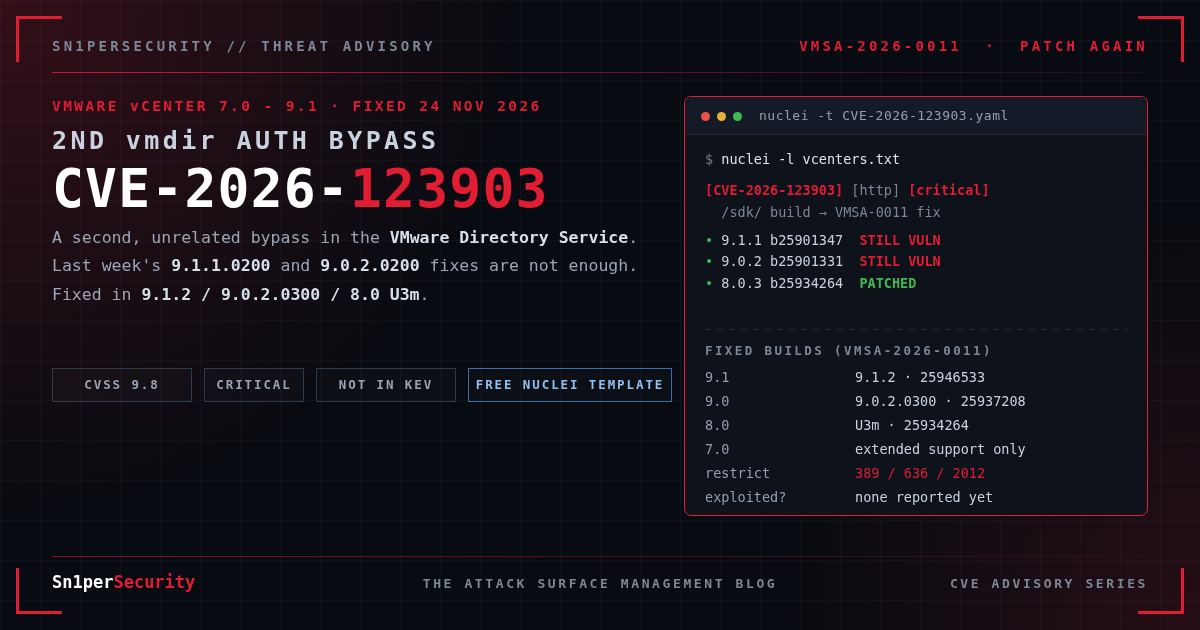

CVE-2026-123903 is a critical authentication bypass in the VMware Directory Service (vmdir) inside VMware vCenter Server. Broadcom disclosed it on 24 November 2026 in VMSA-2026-0011, with a CVSS v3.1 score of 9.8 and no workaround: “a malicious actor with network access to vCenter may exploit this issue to bypass authentication and gain unauthorized access to the system.” It arrived five days after CVE-2026-123890, a different vmdir bypass in the same component that a suspected PRC-nexus group had been exploiting as a zero-day since September. Broadcom says the two are unrelated. They do have the same consequence, and the fixes overlap only partly, which is why the most common question this week is simple: did I just patch vCenter for nothing?
For most vCenter 8.0 shops the answer is no, because 8.0 U3m fixes both. For anyone on 9.0 or 9.1 who patched to the CVE-2026-123890 builds last week, the answer is yes, patch again. This post is three things. First, a plain-English account of what is known and what is not, including where Broadcom’s own documents disagree. Second, a free, non-destructive Nuclei template that reads the vCenter build without logging in and flags anything below the VMSA-2026-0011 fixed build for its line. That includes the 9.x builds that were “fixed” a week ago. Third, how to find every vCenter across your environment with Sn1per. Broadcom credits three teams with reporting the issue independently: mochazz of sglab at Qianxin, Qi Qin (@LeoQ7_) of depthfirst, and VulTeam and XGTP of ThreatBook.
One rule first: do not try to reproduce this bug to “confirm” it. A successful test is an administrator session on your identity provider. Everything in this post is a build read or a port reachability check.
CVE-2026-123903 at a glance
- CVE / advisory: CVE-2026-123903, VMSA-2026-0011 (24 November 2026, initial advisory)
- Impact: unauthenticated access to vCenter through the VMware Directory Service, the store behind vCenter Single Sign-On
- CVSS v3.1: 9.8 Critical,
CVSS:3.1/AV:N/AC:L/PR:N/UI:N/S:U/C:H/I:H/A:H(Broadcom as CNA). NVD has not published the record yet, so there is no NVD score or CWE. - Affected: vCenter 9.1.x, 9.0.x, 8.0 and 7.0; VMware Cloud Foundation 5.x; Telco Cloud Platform 3.0 through 5.2 and Telco Cloud Infrastructure 3.0
- Fixed: vCenter 9.1.2 (build 25946533), 9.0.2.0300 (build 25937208), 8.0 U3m (build 25934264), VCF 5.2.5. No public fix for 7.0.
- Not enough: 9.1.1.0200 and 9.0.2.0200, the CVE-2026-123890 fixes from last week
- Exploitation: none reported by Broadcom, and not in CISA KEV as of catalog 2026.11.24. A GitHub repository claiming a working exploit appeared on the day of disclosure; we have not reviewed or run it.
- Fix now: patch to the VMSA-2026-0011 build for your line, restrict vCenter’s directory ports to management hosts, and audit who is an SSO administrator.
What is CVE-2026-123903?
The VMware Directory Service is the LDAP directory inside every vCenter appliance. It holds the SSO domain (vsphere.local by default): users, groups, the Administrators group, tenant certificates and the keys vCenter uses to sign SAML tokens. It listens on LDAP (389), LDAPS (636) and a DCE/RPC control interface on 2012. Whoever controls vmdir controls who is allowed to log in to vCenter, and through vCenter to every ESX host it manages.
Broadcom’s description of CVE-2026-123903 is a single sentence, the same one it used for CVE-2026-123890: “VMware vCenter contains an authentication bypass vulnerability in the VMware Directory Service.” The advisory does not name a port, a protocol or a code path. The FAQ adds only that the issue “is a new and distinct issue” from CVE-2026-123890 and that it is present whether or not you use Enhanced Linked Mode.
One public claim fills in more, and we label it as a claim. On 24 November a GitHub repository was published describing CVE-2026-123903 as a flaw in vmdir’s LDAP SASL bind handling. According to its README, a failed SASL bind that names a privileged identity leaves that identity attached to the connection, so later LDAP operations on the same connection run with its rights. The README says this allows an account to be created and added to the Administrators group without credentials. We have not reviewed or run that code, and Broadcom has neither confirmed nor denied the mechanism. If the claim is accurate, it matters for defense: the entry point would be LDAP on 389 and 636, not the DCE/RPC port 2012 that CVE-2026-123890 used. A firewall rule written last week for 2012 alone would not cover it.
This is the third vmdir authentication bypass Broadcom has fixed in four months. CVE-2026-59309 (VMSA-2026-0006, July) was an LDAP bypass, CVE-2026-123890 (VMSA-2026-0009, 19 November) was an SRP session-key disclosure over 2012, and now CVE-2026-123903. Three independent teams found this one. That says something about how much attention vmdir is getting, and about how likely it is that someone else has it too.
VMSA-2026-0011 also fixes six other vCenter issues: an arbitrary file write while processing certain archives (CVE-2026-123904, 7.5, which needs access to the backup repository), three vmdir denial-of-service bugs (CVE-2026-123905, -123906 and -123907, 7.5 each), a local privilege escalation in a vpxd service script (CVE-2026-123908, 6.7) and a vSphere Distributed Switch policy enforcement failure (CVE-2026-123909, 5.2). The same advisory fixes two critical ESX code execution bugs in the I/O filter service (CVE-2026-123910 and CVE-2026-123911). Those need the ESX update, which is a separate change from vCenter.
Affected and fixed versions
The fixed versions come from the VMSA-2026-0011 response matrix. The build numbers come from Broadcom’s release notes for each version. Compare builds, not version strings: 9.1.1.0200 and 9.1.2 both report a 9.1.x version, and 8.0 U3k and U3m both report 8.0.3.
| vCenter line | Fixed for CVE-2026-123890 (VMSA-2026-0009) | Fixed for CVE-2026-123903 (VMSA-2026-0011) | Patch again if you are on |
|---|---|---|---|
| 9.1.x (VCF / VVF 9.1) | 9.1.1.0200, build 25901347 | 9.1.2, build 25946533 | 9.1.1.0200 or anything older |
| 9.0.x (VCF / VVF 9.0) | 9.0.2.0200, build 25901331 | 9.0.2.0300, build 25937208 | 9.0.2.0200 or anything older |
| 8.0 | 8.0 U3m, build 25934264 | 8.0 U3m, build 25934264 | only if you are below U3m |
| 7.0 | no public fix | no public fix; extended-support customers contact Broadcom | upgrade |
| VCF 5.x | vCenter 8.0 U3m + SDDC Manager 5.2.5 | vCenter 8.0 U3m via KB 88287 | only if vCenter is below U3m |
| Telco Cloud Platform / Infrastructure | KB 463116 | KB 463501 | per KB 463501 |
Where Broadcom’s documents disagree. Three details do not line up, and the safe reading is the same for all three: trust the response matrix and install the newest build for your line.
- The vCenter 9.1.2.0 release notes say the release “resolves CVE-2026-123906, CVE-2026-123907, CVE-2026-123908, and CVE-2026-123909”. CVE-2026-123903 is not on that list, but the VMSA names 9.1.2 as its fix.
- The vCenter 9.0.2.0300 release notes list only ESX CVEs (123910 to 123916) as resolved. That looks like an error in the notes.
- The 8.0 U3m release notes, published on 19 November, mention only CVE-2026-123890, yet the matrix says U3m fixes CVE-2026-123903 as well.
The advisory explains part of this: “While some CVEs were initially addressed in the older releases, the versions mentioned in the response matrix are the latest available and contain all the fixes.” So CVE-2026-123903 may have been closed quietly in an earlier build. Broadcom does not say which one, so you cannot rely on it. Our template uses the matrix builds, which is the conservative choice. It may flag a host that is in fact already fixed, but it will not clear one that is not.
7.0 again. The VMSA-2026-0011 matrix lists vCenter 7.0 as affected, with the fix “Contact Broadcom Support if you have extended support contract.” vSphere 7 left general support on 2 October 2025. If you still run it, the port restrictions below are the only control you have until you upgrade.
Staged is not installed. A patch downloaded in the VAMI or approved in Lifecycle Manager does nothing until the update completes and services restart. Broadcom also notes the vCenter updates in this advisory are not eligible for vCenter Quick Patch, so plan a conventional update window.
How the exploit chain works
Broadcom has published no technical detail, and the researchers have not published write-ups. The skeleton below combines the advisory’s one line with the unverified repository claim, at the level a defender needs:
TCP connect  vcenter:389 or :636                 (vmdir LDAP - per the unverified repository claim)
LDAP bind    [REDACTED - SASL bind naming a privileged identity, designed to fail]
LDAP ops     [REDACTED - same connection, now acting as that identity]
-> create a directory account, add it to cn=Administrators,cn=Builtin
-> log in to vCenter as an SSO administrator
Once an attacker has an SSO administrator account, everything we described for CVE-2026-123890 follows. They can read the vmdir database and the SAML signing key, forge logins, enable SSH through the VAMI, and reach every ESX host and virtual disk that vCenter manages. ARMORY CASTLE did exactly that with the sibling bug.
We are deliberately not publishing bind parameters, request sequences or anything that would help reproduce the bypass. That is the same line we took for CVE-2026-123890 last week, and in every advisory in this series. The repository that appeared on disclosure day may or may not work. Fake proof-of-concept code for a fresh, high-profile CVE is a common way to deliver malware to exactly the people who run it, and real code is worse. Do not run either on your network. Assume that if it does not work yet, something like it soon will.
Am I affected? Quick manual checks
Check the vCenter build from inside
The authoritative check is the running build. It is on the vCenter Summary tab in the vSphere Client, or in PowerCLI:
Connect-VIServer vcenter.example.com
$global:DefaultVIServer.Version
$global:DefaultVIServer.Build
Compare the build against the table: 9.1 needs at least 25946533, 9.0 at least 25937208, 8.0 at least 25934264. Every 7.0 build is affected.
Check whether vCenter is vulnerable to CVE-2026-123903 without logging in
vCenter answers the SOAP RetrieveServiceContent call before authentication, and the response carries the product, version and build:
curl -sk https://vcenter.example.com/sdk/ -H 'Content-Type: text/xml' --data \
'<soap:Envelope xmlns:soap="http://schemas.xmlsoap.org/soap/envelope/" xmlns:xsi="http://www.w3.org/2001/XMLSchema-instance"><soap:Body><RetrieveServiceContent xmlns="urn:internalvim25"><_this xsi:type="ManagedObjectReference" type="ServiceInstance">ServiceInstance</_this></RetrieveServiceContent></soap:Body></soap:Envelope>' \
| grep -oE '<(fullName|version|build|apiType)>[^<]*'
A 9.1 vCenter patched last week for CVE-2026-123890 returns fullName>VMware vCenter Server 9.1.1 build-25901347, which is still vulnerable to CVE-2026-123903. Only trust responses where apiType is VirtualCenter. ESX hosts answer the same call with HostAgent and their own build numbers, and mixing the two produces false positives.
Which vCenter ports matter for CVE-2026-123903?
Broadcom only says “network access to vCenter”. vmdir listens on 389, 636 and 2012, and the unverified claim points at LDAP. Check all three, from every network zone that matters:
nmap -Pn -p 389,636,2012 --open vcenter.example.com
None of them should be reachable from user networks or the internet. In last week’s intrusion, the attackers reached vCenter from a compromised internal Linux appliance, not from outside.
Nuclei detection template for CVE-2026-123903
The template reads the build through /sdk/ and flags anything below the VMSA-2026-0011 fixed build for its release line. It is the same mechanism as our CVE-2026-123890 template with new floors, so the two together tell you which vCenters need which update.
id: CVE-2026-123903

info:
  name: VMware vCenter Server - vmdir Authentication Bypass (CVE-2026-123903)
  author: xer0dayz
  severity: critical
  description: |
    VMware vCenter Server contains an authentication bypass in the VMware Directory
    Service (vmdir) that lets an unauthenticated actor with network access to vCenter
    gain unauthorized access (VMSA-2026-0011, CVSS 9.8). Distinct from CVE-2026-123890.

    This template is NON-DESTRUCTIVE: it sends one unauthenticated SOAP
    RetrieveServiceContent request to /sdk (the same call every vSphere client makes
    before login), confirms apiType is VirtualCenter (ESXi hosts are ignored), extracts
    the version and build, and flags builds below the VMSA-2026-0011 fixed build for
    each release line. It sends no LDAP, SASL, RPC or authentication traffic.
  remediation: |
    Upgrade to vCenter 9.1.2 (build 25946533), 9.0.2.0300 (build 25937208) or 8.0 U3m
    (build 25934264); VCF 5.x via vCenter 8.0 U3m. 9.1.1.0200 and 9.0.2.0200 are NOT
    sufficient. No public fix for 7.0. Restrict vmdir ports 389, 636 and 2012.
  reference:
    - https://support.broadcom.com/web/ecx/support-content-notification/-/external/content/SecurityAdvisories/0/39626
    - https://github.com/vmware/vcf-security-and-compliance-guidelines/blob/main/security-advisories/vmsa-2026-0011/README.md
    - https://knowledge.broadcom.com/external/article/326316/build-numbers-and-versions-of-vmware-vce.html
    - https://www.cve.org/CVERecord?id=CVE-2026-123903
  classification:
    cvss-metrics: CVSS:3.1/AV:N/AC:L/PR:N/UI:N/S:U/C:H/I:H/A:H
    cvss-score: 9.8
    cve-id: CVE-2026-123903
  metadata:
    verified: false
    max-request: 1
    vendor: vmware
    product: vcenter_server
    shodan-query: http.title:"ID_VC_Welcome"
  tags: cve,cve2026,vmware,vcenter,vmdir,auth-bypass,passive

http:
  - raw:
      - |
        POST /sdk/ HTTP/1.1
        Host: {{Hostname}}
        Content-Type: text/xml; charset=utf-8

        <?xml version="1.0" encoding="UTF-8"?>
        <soap:Envelope xmlns:soap="http://schemas.xmlsoap.org/soap/envelope/" xmlns:xsd="http://www.w3.org/2001/XMLSchema" xmlns:xsi="http://www.w3.org/2001/XMLSchema-instance">
           <soap:Header>
              <operationID>00000001-00000001</operationID>
           </soap:Header>
           <soap:Body>
              <RetrieveServiceContent xmlns="urn:internalvim25">
                 <_this xsi:type="ManagedObjectReference" type="ServiceInstance">ServiceInstance</_this>
              </RetrieveServiceContent>
           </soap:Body>
        </soap:Envelope>

    matchers-condition: or
    matchers:
      - type: dsl
        name: vcenter-9.1-below-9.1.2
        dsl:
          - "api_type == 'VirtualCenter' && compare_versions(version, '>= 9.1', '< 9.2') && compare_versions(build, '< 25946533')"

      - type: dsl
        name: vcenter-9.0-below-9.0.2.0300
        dsl:
          - "api_type == 'VirtualCenter' && compare_versions(version, '>= 9.0', '< 9.1') && compare_versions(build, '< 25937208')"

      - type: dsl
        name: vcenter-8.0-below-8.0u3m
        dsl:
          - "api_type == 'VirtualCenter' && compare_versions(version, '>= 8.0', '< 8.1') && compare_versions(build, '< 25934264')"

      - type: dsl
        name: vcenter-7.0-no-public-fix
        dsl:
          - "api_type == 'VirtualCenter' && compare_versions(version, '>= 7.0', '< 7.1')"

      - type: dsl
        name: vcenter-6.x-end-of-support-presumed-affected
        dsl:
          - "api_type == 'VirtualCenter' && compare_versions(version, '>= 6.0', '< 7.0')"

    extractors:
      - type: regex
        name: api_type
        internal: true
        part: body
        group: 1
        regex:
          - '<apiType>([A-Za-z]+)</apiType>'

      - type: regex
        name: version
        internal: true
        part: body
        group: 1
        regex:
          - '<version>([0-9]+\.[0-9]+(?:\.[0-9]+)?)</version>'

      - type: regex
        name: build
        internal: true
        part: body
        group: 1
        regex:
          - '<build>([0-9]+)</build>'

      - type: regex
        name: vcenter_full_name
        part: body
        group: 1
        regex:
          - '<fullName>(VMware vCenter Server [^<]+)</fullName>'
Save it as CVE-2026-123903.yaml and run it, ideally alongside the CVE-2026-123890 template so one pass shows both gaps:
nuclei -t CVE-2026-123903.yaml -l vcenters.txt
nuclei -t CVE-2026-123903.yaml -t CVE-2026-123890.yaml -l vcenters.txt
A match names the release line and the fix you need, and shows the running build:
[CVE-2026-123903:vcenter-9.1-below-9.1.2] [http] [critical] https://vc01.example.com/sdk/ ["VMware vCenter Server 9.1.1 build-25901347"]
[CVE-2026-123903:vcenter-8.0-below-8.0u3m] [http] [critical] https://vc02.example.com/sdk/ ["VMware vCenter Server 8.0.3 build-25600417"]
[CVE-2026-123903:vcenter-7.0-no-public-fix] [http] [critical] https://vc-legacy.example.com/sdk/ ["VMware vCenter Server 7.0.3 build-24927011"]
We tested it against a mock that serves the real AboutInfo structure. The 17 cases cover each line’s fixed build minus one, the fixed build and a later build, plus the two CVE-2026-123890 fix builds that must still be flagged, a two-part version string, 7.0, 6.7, two ESX profiles and a non-VMware server. It validates cleanly on nuclei v3.11.1. We have not run it against a production vCenter, so it ships as verified: false.
Three blind spots, stated plainly:
- It is conservative by design. It uses the response matrix builds. If CVE-2026-123903 was in fact closed in an earlier build, as the release notes hint, a few patched hosts will be flagged. We think that is the right trade for an authentication bypass.
- Silence means unknown, not clean. A vCenter whose
/sdk/sits behind a proxy, WAF or allow-list returns noAboutInfo, and the template says nothing. Check those from inside or with PowerCLI. - A build is not evidence of compromise. A patched build says nothing about what happened before you patched. That needs the audit steps below.
Detecting CVE-2026-123903 across your attack surface with Sn1per
Three vmdir bypasses in four months means the vCenter inventory you built in July is already out of date, and the vCenters that stay vulnerable are the ones nobody updated because nobody knew they were there. That is a discovery problem first. Sn1per’s recon modes find the hosts, services and directory ports, and the curated Nuclei set checks the builds on everything it finds.
# discover hosts and services, including vCenter on 443 and vmdir on 389/636/2012
sniper -t example.com -m recon -w vcenter-123903

# run the web checks, including the curated Nuclei set, on every HTTP(S) port found
sniper -t example.com -m web -w vcenter-123903

# internal management ranges, where vCenter actually lives
sniper -f mgmt-subnets.txt -m airstrike -w vcenter-123903-internal
Pull the findings into your ticketing system with the Professional JSON API:
curl -sk -H "X-API-Key: $SN1PER_API_KEY" \
  "https://sn1per.local/pro/api.php?action=vulnerabilities&workspace=vcenter-123903" \
  | jq '.[] | select(.name | test("CVE-2026-(123903|123890)"))'
A current list of every vCenter you own, with its build, which advisory it is missing and which zones can reach its directory ports, is the first thing an attacker would want. It should stay on infrastructure you control. Sn1per runs there, which is the point of external attack surface management with Sn1per.
Which Sn1per edition fits
| Capability | Community | Professional 2026 | Enterprise |
|---|---|---|---|
| Run the CVE-2026-123903 template | Yes | Yes | Yes |
| Curated Nuclei set maintained for you | Partial | Yes | Yes |
| Workspaces and scan history | Basic | Yes | Yes |
| Web UI with asset risk ranking | No | Yes | Yes |
| JSON API for finding export | No | Yes | Yes |
| Scheduled recurring surface sweeps | No | Limited | Yes |
| Multi-user, delegated workspaces | No | No | Yes |
A one-off answer needs only Community and the template. The more important lesson of this week is that a build you verified on Friday can be one advisory behind by Monday. Scheduled sweeps and scan history catch that drift, which is the argument for continuous attack surface testing over a single scan.
Remediation and mitigation
- Patch to the VMSA-2026-0011 build for your line. 9.1.x goes to 9.1.2 and 9.0.x to 9.0.2.0300, even if you installed 9.1.1.0200 or 9.0.2.0200 last week. 8.0 U3m already covers both CVEs, so 8.0 shops that applied it do not need another vCenter update. VCF 5.x applies vCenter 8.0 U3m through KB 88287. Broadcom says the vCenter update does not interrupt running workloads.
- Do not stop at vCenter. VMSA-2026-0011 also fixes two critical ESX code execution bugs (CVE-2026-123910 and CVE-2026-123911) that need the ESX update, and a VMware Tools issue that needs Tools updated inside each guest. If you skipped the SDDC Manager update from VMSA-2026-0009, apply that separately.
- Restrict every vmdir port, not just 2012. LDAP 389, LDAPS 636 and DCE/RPC 2012 should be reachable only from vCenter peers and privileged management workstations. If you added a 2012 rule for CVE-2026-123890, extend it to cover 389 and 636. Mandiant’s guidance for the sibling bug is to enforce this with kernel-level iptables on the appliance, because the VAMI firewall is coarse, logs nothing, and can be switched off by anyone who reaches the VAMI.
- Treat 7.0 as unpatchable unless you hold extended support. Request the fix through that channel or upgrade. Until then, the port restrictions in step 3 are the only control you have.
- Audit SSO administrators. List the members of the Administrators group in the SSO domain and every user with administrator rights, and investigate anything you did not create. Then check the vmdir logs under
/var/log/vmware/vmdird/for failed binds followed by directory writes, which is the pattern the public claim describes. Also run the CVE-2026-123890 hunting steps, because that bug was exploited for months before anyone knew about it. - Plan for a fourth. Three teams found this bug independently, and the component has now had three bypasses since July. Keeping directory ports restricted, admin accounts audited and builds monitored will matter more than any single patch.
Frequently asked questions
What is CVE-2026-123903? CVE-2026-123903 is a critical (CVSS 9.8) authentication bypass in the VMware Directory Service in vCenter Server. Broadcom disclosed it on 24 November 2026 in VMSA-2026-0011. An attacker with network access to vCenter can bypass authentication and gain unauthorized access. Broadcom says it is new and distinct from CVE-2026-123890, the vmdir bypass fixed five days earlier. It was reported independently by researchers from Qianxin, depthfirst and ThreatBook.
Do I need to patch vCenter again if I already patched CVE-2026-123890? It depends on your release line. If you applied vCenter 8.0 U3m, no: Broadcom lists 8.0 U3m as the fix for both CVEs. If you are on 9.1.x and installed 9.1.1.0200 for CVE-2026-123890, yes: CVE-2026-123903 needs 9.1.2. If you are on 9.0.x and installed 9.0.2.0200, yes: it needs 9.0.2.0300. ESX needs its own update from the same advisory either way.
What vCenter build fixes CVE-2026-123903? vCenter 9.1.2 is build 25946533, 9.0.2.0300 is build 25937208, and 8.0 U3m (8.0.3.01200) is build 25934264. VCF 5.x is fixed by applying vCenter 8.0 U3m through the asynchronous patching process in KB 88287. There is no public fix for vCenter 7.0; customers with extended support must contact Broadcom.
Is CVE-2026-123903 exploited in the wild? Not as far as public sources show. Broadcom reports no exploitation, and it is not in the CISA Known Exploited Vulnerabilities catalog as of 24 November 2026. A GitHub repository claiming a working exploit appeared on the day of disclosure; we have not reviewed or run it, and you should not run it on your network. The related CVE-2026-123890 was exploited as a zero-day for months before disclosure, so treat the lack of reports as a short window, not reassurance.
Which ports does CVE-2026-123903 use? Broadcom only says “network access to vCenter”. The VMware Directory Service listens on LDAP 389, LDAPS 636 and DCE/RPC 2012. The public repository describes the flaw as an LDAP SASL bind issue, which would point to 389 and 636, but that claim is unverified. Restrict all three to vCenter peers and management workstations, and check reachability from internal zones as well as from the internet.
Is vCenter 7.0 affected by CVE-2026-123903? Yes. The VMSA-2026-0011 response matrix lists vCenter 7.0 as affected, with the fix “Contact Broadcom Support if you have extended support contract.” vSphere 7 reached End of General Support on 2 October 2025. Without extended support there is no patch, so upgrade, and until then block the directory ports from everything except management hosts.
Is the CVE-2026-123903 Nuclei template safe to run in production? Yes. It sends one unauthenticated SOAP request that every vSphere client sends before login, and reads the version and build from the response. It sends no LDAP, SASL or RPC traffic and never touches the directory service. Because it uses the response matrix builds, it is deliberately conservative: it may flag a host that was quietly fixed earlier, but it will not clear one that is still vulnerable.
Closing
The lesson of CVE-2026-123903 is not about one bug. vCenter’s identity store has now had three authentication bypasses in four months, two of them in the same week, one exploited for months by an espionage group and this one found by three teams at once. “Patched last week” is not a status you can rely on. Patch to this week’s builds, close the directory ports you forgot about, audit the admin list, and keep checking the whole estate rather than the vCenters you remember. Run the template across every vCenter you can find today, and run it again next week.
Primary sources: VMSA-2026-0011 and its Questions & Answers, the vCenter 9.1.2.0, vCenter 9.0.2.0300 and vCenter 8.0 U3m release notes, VMSA-2026-0009, the CVE record and the CISA KEV catalog, all read on 24 November 2026.