

Search for the best on-prem external attack surface management platform and you will find a dozen vendors that claim to support on-premises environments. Read the fine print and most of them tell a different story: the platform itself is Software-as-a-Service. Your domains, IP ranges, certificates, exposed services, and discovered vulnerabilities are processed on the vendor’s cloud and stored in their multi-tenant database. “On-prem support” usually means the tool can see your on-prem assets, not the tool runs inside your perimeter.
For a lot of security teams that distinction does not matter. For regulated enterprises, defense contractors, financial institutions, and any organization that treats its own attack-surface data as sensitive, it is the entire decision. This guide explains what genuinely self-hosted External Attack Surface Management (EASM) means in 2026, the criteria that separate real on-prem platforms from SaaS in disguise, and how the leading options compare – including where Sn1per fits as an all-in-one self-hosted ASM platform.
What “on-prem EASM” actually means
External Attack Surface Management is the continuous discovery, inventory, and assessment of everything an attacker can reach from the public internet: domains and subdomains, IP ranges, open ports, running services, TLS certificates, login portals, cloud buckets, forgotten staging hosts, and the vulnerabilities sitting on all of them. The job is to see your organization the way an attacker does – from the outside in – and to keep seeing it as the surface changes.
An on-prem or self-hosted EASM platform performs that work from infrastructure you own and control. The scanning engine, the asset database, the findings, and (increasingly) the AI models used to analyze them all live inside your network boundary. Nothing about your attack surface is transmitted to, processed by, or retained on a third-party SaaS backend. When a scan finishes, the results are written to a database on a host you administer.
That is a stricter definition than most “on-prem” marketing implies, and it is the definition that matters for data sovereignty. We break the deployment-model spectrum down in detail in our companion guide, On-Prem vs Cloud Attack Surface Management.
Why on-prem EASM is having a moment in 2026
The pull toward self-hosting is not nostalgia for the data-center era – it is a response to concrete pressure that intensified through 2025 and into 2026:
- Regulation with teeth. The EU AI Act reached its main application date on 2 August 2026, with penalties of up to 7% of global annual turnover for prohibited practices. GDPR Article 28 already turns any SaaS security vendor into a data processor you must paper, audit, and trust in your breach-notification chain.
- Jurisdictional risk. The US CLOUD Act lets American authorities compel data from US-headquartered providers regardless of where the servers physically sit. For non-US organizations, that alone can disqualify a US SaaS vendor from holding sensitive recon data.
- The cost of getting it wrong. IBM’s Cost of a Data Breach report put the global average breach at USD 4.88M, with financial services higher still. A catalogue of your every exposed asset and unpatched vulnerability is precisely the kind of data you do not want sitting in someone else’s cloud.
- The market is following. Major vendors that built their identity on cloud delivery are now shipping zero-cloud-dependency, air-gapped, and sovereign deployment options – an admission that a meaningful slice of the market will not, or cannot, send this data off-site.
The catch: “on-prem support” is not the same as self-hosted
This is the single most important thing to verify, because the category is genuinely confusing. There are three different things vendors mean when they say “on-prem”:
- Covers on-prem assets (still SaaS). The platform discovers and monitors your on-premises and hybrid assets, but the platform itself runs in the vendor’s cloud. Most of the well-known EASM names – the ones that show up in analyst grids – fall here. Your asset inventory leaves your perimeter.
- Connector or collector on-prem (mostly SaaS). A lightweight collector runs inside your network, but it ships data back to a SaaS control plane for storage, correlation, and reporting. Better, but your findings still land in the cloud.
- Genuinely self-hosted. The entire platform – engine, database, UI, reporting, and AI analysis – installs and runs on your infrastructure. No findings leave unless you choose to send them.
Only the third category satisfies a strict data-residency or air-gap requirement. When you evaluate a platform, the question is not “does it support on-prem?” It is “where is my attack-surface data stored after a scan, and can the product function with the network cable unplugged?”
Eight criteria for a real on-prem EASM platform
Use this checklist to cut through the marketing. A genuinely self-hosted platform should satisfy most or all of these:
- Data residency. All discovered assets, findings, and reports persist to a database on hardware you control. No telemetry of findings to the vendor.
- Air-gap capable. The platform installs and runs with no outbound internet dependency – no license phone-home, no mandatory cloud auth, no “cannot scan until you reconnect.”
- Own reconnaissance, not a borrowed cloud graph. Classic SaaS EASM leans on a shared internet-wide intelligence graph the vendor maintains. A self-hosted platform performs its own active and passive discovery from your egress, so the capability travels with the install.
- Local AI inference (optional but increasingly decisive). If the platform uses AI, it should support a local model runtime so prompts and findings are never shipped to a third-party LLM API.
- Deployment you control. Docker, a documented bare-metal installer, or both – reproducible on Kali, Ubuntu, or Debian without a vendor-operated SaaS account.
- Programmatic export. A JSON/CSV API or SARIF output so findings flow into your SIEM, ticketing, and CI/CD – not a vendor portal you have to log into.
- Source availability or auditability. For regulated buyers, the ability to inspect the code and confirm no data exfiltration is a procurement requirement, not a nicety. A self-hosted claim you cannot verify is just a claim.
- Honest licensing. Per-install or per-seat licensing that does not meter your scans through the vendor’s cloud (which would re-introduce the dependency you were trying to remove).
The 2026 landscape, sorted by where your data lives
Here is the field organized by the only axis that matters for on-prem buyers – data residency – rather than by analyst hype. This is a deliberately honest map; several capable products are SaaS, and that is fine for teams without a residency constraint.
| Category | Representative tools | Where your attack-surface data lives | Air-gap? |
|---|---|---|---|
| SaaS EASM (covers on-prem assets) | Microsoft Defender EASM, CrowdStrike Falcon Surface, Censys, Wiz, Mandiant ASM | Vendor cloud (multi-tenant) | No |
| Self-hosted, EASM-focused | ScanFactory, ImmuniWeb Discovery (hybrid) | Mostly your infrastructure | Partial |
| Open-source DIY stack | OWASP Amass, reNgine, Nmap, Faraday | Your infrastructure | Yes (you assemble it) |
| All-in-one self-hosted platform | Sn1per Professional / Enterprise | Your infrastructure (PostgreSQL on a host you own) | Yes |
Microsoft’s own documentation is refreshingly clear on this point: Defender EASM is not suitable if you need a fully on-prem, self-hosted solution with no SaaS dependency. That is true of most of the top row. The genuinely self-hosted options are far fewer than the category’s noise would suggest – which is exactly why the term is worth ranking for and worth getting right.
The open-source DIY stack vs. an all-in-one platform
You can absolutely build self-hosted EASM from free parts: OWASP Amass for asset discovery, Nmap for port and service enumeration, a fingerprinting tool for technology identification, and Faraday to aggregate it all. Everything stays on your machine. For a single operator with time to wire it together, it is a legitimate path, and we cover it in depth in Open-Source & Self-Hosted ASM Tools.
The DIY stack hits a ceiling around the things commercial platforms exist to provide: a unified asset database, continuous re-scanning on a schedule, deduplicated findings with severity, exportable reports for auditors, and a single pane of glass instead of a directory of text files. That is the gap an all-in-one self-hosted platform closes – without giving up the data residency that made you choose self-hosting in the first place.
Why Sn1per is built for on-prem EASM
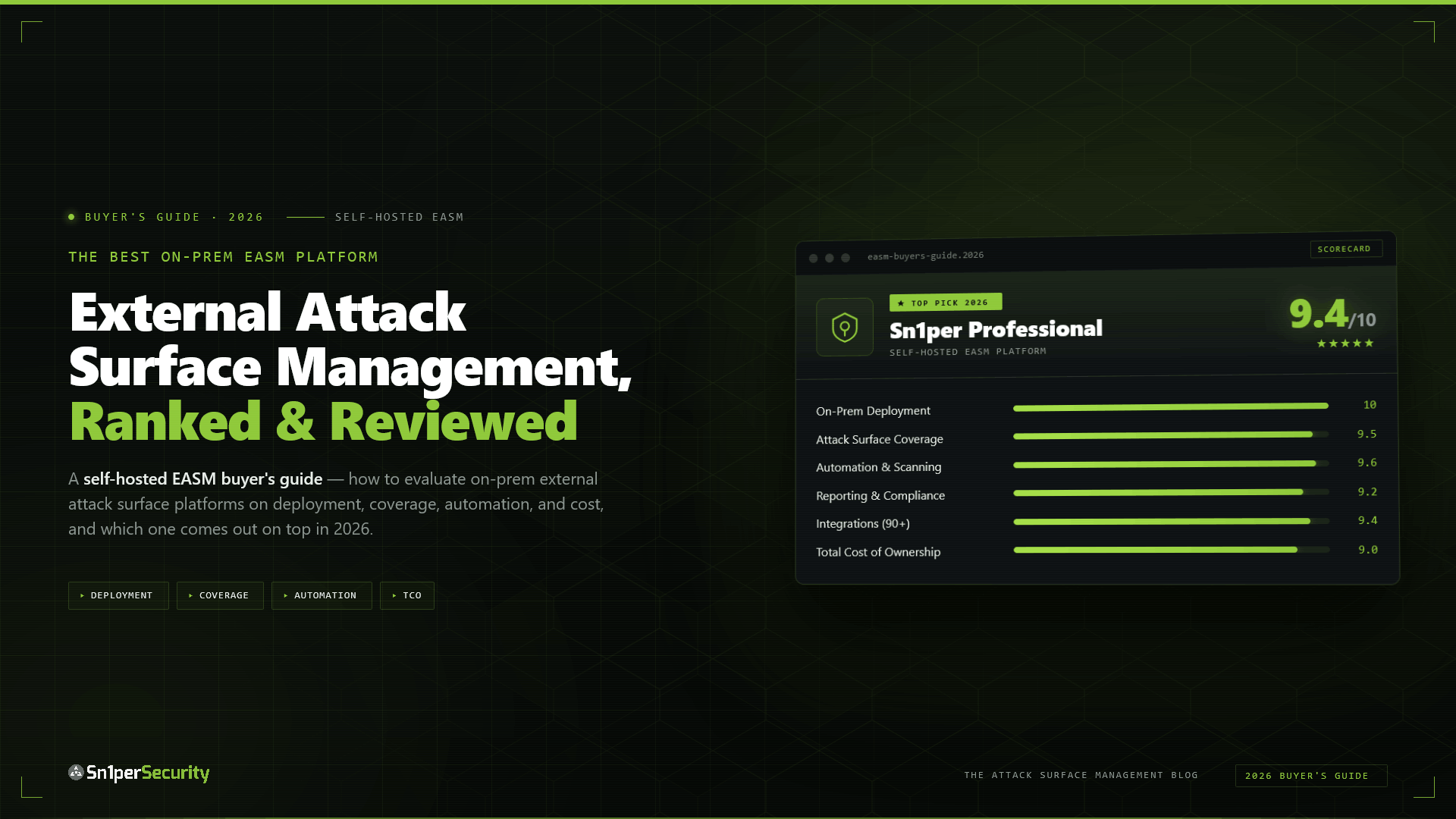
Sn1per is an offensive-security platform that consolidates reconnaissance, vulnerability scanning, exploitation, and reporting into one workspace, and it has been self-hosted by design since 2015. It orchestrates 90+ third-party security tools, ships 600+ exploits and 10,000+ detections, and runs entirely on infrastructure you control. It is used by 500+ teams worldwide. Crucially, it does its own active and passive reconnaissance from your egress – it does not depend on a vendor-operated cloud graph – so the discovery capability is fully portable into an isolated network.
The platform comes in three released editions that share one scanning engine:
- Sn1per Community Edition – the free, source-available command-line core. Recon, vulnerability scanning, and attack-surface discovery from your terminal.
- Sn1per Professional 2026 – adds the self-hosted web UI, the Workspace Navigator, scheduled scans, exportable Workspace and Host reports, and a JSON API v1.0 for headless integration. Docker-first, so a full instance stands up with a single
docker compose up. - Sn1per Enterprise – the same engine at SOC scale: multi-workspace, multi-operator, API-first, unlimited targets.
Compare the editions side by side in Sn1per Professional vs Enterprise.
Stand up a self-hosted instance
Sn1per Professional 2026 is Docker-first. The image is built on Kali rolling with Apache, PHP 8.4, SSL, and HTTP Digest auth baked in, backed by a PostgreSQL service and a bind-mounted loot directory so findings persist on your host:
# Clone and bring up a fully self-hosted Pro instance
git clone https://your-internal-mirror/sn1per-pro-2026.git
cd sn1per-pro-2026
docker compose up -d sn1per-pro

# Web UI on https://localhost:1337 - data in your PostgreSQL, on your host
Deploy into an air-gapped network
For isolated or classified environments, export the image on a connected build host, carry it across the gap, and load it on the target – no registry pull, no license phone-home at scan time:
# On a connected build host
docker save sn1per-pro-2026:latest -o sn1per-pro-2026.tar

# Transfer sn1per-pro-2026.tar across the air gap, then on the isolated host:
docker load -i sn1per-pro-2026.tar
docker compose up -d sn1per-pro
Run a scan, keep the data local
Every scan writes to your local workspace. Nothing about the target leaves the host:
# Full external attack-surface sweep against a client domain, into a named workspace
sniper -t client-acme.com -m web -w acme

# CIDR discovery sweep across an owned range
sniper -t 203.0.113.0/24 -m discover -w acme
Pull findings into your own stack
The JSON API v1.0 lets your SIEM, ticketing, or CI/CD pull findings directly – integration on your terms, with an X-API-Key header for headless use:
curl -sk -H "X-API-Key: $SN1PER_API_KEY"
  "https://localhost:1337/api.php?action=vulnerabilities&workspace=acme"
Keep AI analysis in-perimeter, too
If you want AI in the loop, it should follow the same rule as the rest of your stack: never leave the perimeter. SILENTCHAIN AI Community Edition is a free Burp Suite extension that analyzes HTTP traffic for OWASP Top 10 issues and supports five AI providers – including a local Ollama runtime, so model inference stays on your machine. It pairs naturally with a self-hosted Sn1per deployment when you want AI-assisted web testing without shipping requests to a third-party LLM API.
The compliance payoff
Self-hosting is not just an architecture preference; it changes your regulatory posture. When the platform runs in your perimeter, you are both controller and processor of the recon data: there is no Data Processing Agreement to negotiate under GDPR Article 28, no sub-processor chain to audit, and no dependency on a vendor’s incident-response clock to meet your own Article 33 72-hour breach-notification obligation. For defense and classified work, a platform that runs with the network cable unplugged is the only kind that can run at all. We map this out fully in On-Prem vs Cloud ASM.
The verdict
If you have no data-residency constraint, a polished SaaS EASM is a fine choice and often the path of least resistance. If your attack-surface data is sensitive – because of regulation, jurisdiction, a defense mandate, or simple prudence – the field narrows fast, because most “on-prem” products are SaaS that merely looks at on-prem assets. Among platforms that genuinely run inside your perimeter, do their own reconnaissance, support air-gapped deployment, and still give you a web UI, scheduled scans, reports, and an API, Sn1per Professional and Enterprise are the most complete all-in-one option in 2026 – with a free Community Edition to start from and a local-AI companion in SILENTCHAIN Community.
Start free with Sn1per Community Edition, stand up the self-hosted web platform with Sn1per Professional 2026, or browse every edition on the shop page.
Frequently asked questions
What is the difference between on-prem and self-hosted EASM?
In practice they mean the same thing: the External Attack Surface Management platform – engine, database, UI, and analysis – runs on infrastructure you own and control, so discovered assets and findings never leave your perimeter. Watch for vendors who say “on-prem” but only mean their SaaS can monitor your on-premises assets.
Can an attack surface management platform run air-gapped?
Yes, if it is genuinely self-hosted. Sn1per, for example, can be exported as a Docker image, transferred across an air gap, and run with no outbound internet dependency – no license phone-home or cloud authentication required at scan time. SaaS EASM platforms cannot operate without connectivity to their cloud backend.
Is on-prem EASM required for GDPR or data-residency compliance?
It is not strictly mandated, but self-hosting is the cleanest way to satisfy strict data-residency requirements. Running the platform yourself makes you both controller and processor, removing the Data Processing Agreement, sub-processor audit, and breach-notification dependency that a SaaS vendor introduces under GDPR Article 28.
Is there a free on-prem attack surface management tool?
Yes. Sn1per Community Edition is a free, source-available command-line platform for self-hosted reconnaissance and attack-surface discovery, and open-source tools like OWASP Amass and Nmap cover individual stages. Paid editions add the web UI, scheduling, reporting, and API.
Does self-hosted EASM mean weaker discovery than cloud platforms?
Not inherently. Cloud EASM leans on a shared internet-wide intelligence graph; a self-hosted platform performs its own active and passive reconnaissance from your egress. The trade-off is operational rather than capability: you run the scans and own the data, instead of querying a vendor’s graph.