
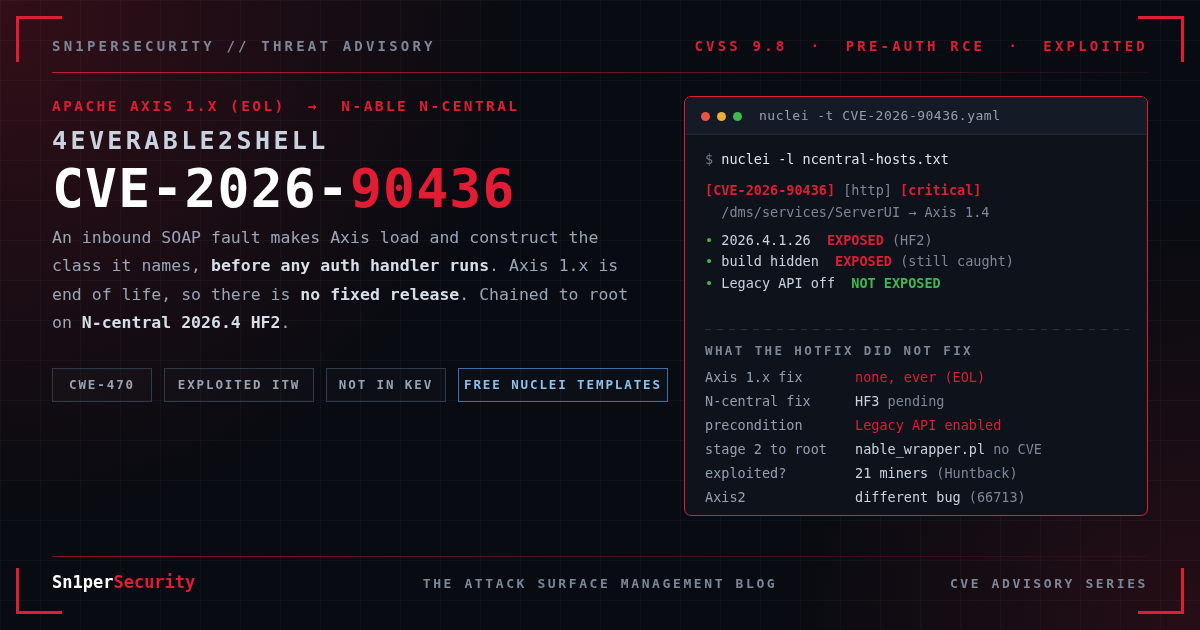

CVE-2026-90436 is a pre-authentication flaw in Apache Axis 1.x that lets an attacker make the server load and instantiate a Java class of their choosing by sending it a SOAP fault. Apache disclosed it on 6 November 2026 and marked it “unsupported when assigned”: Axis 1.x has been end of life for years, and there will be no fixed release. Six days later it became the front door of 4EverAble2Shell, a public exploit chain that takes an on-premises N-able N-central server from an unauthenticated HTTP request to root. N-central is the remote monitoring and management platform behind a large share of managed service providers, so one compromised server is a foothold into every customer network it manages. The chain works against N-central 2026.4 Hotfix 2, the security release N-able shipped on 10 November, and Huntback counted 21 servers running a cryptominer within hours of the proof of concept going public.
This post covers three things. First, a plain-English explanation of the Axis bug, the N-central chain built on top of it, and why the CVE will outlive this week’s news cycle. Second, two free, passive Nuclei templates: one for the N-central entry point and one for any Apache Axis 1.x engine, both verified against a real Axis 1.4 deployment. Third, how to find every affected host across an attack surface, including the Axis copies buried inside products nobody thinks of as “running Axis”. The Axis flaw was found by José Apari-Pantigozo of OKIOK. The 4EverAble2Shell chain was published by Sean Bales, and the exploitation data comes from Huntback.
One rule before anything else: do not test this by sending a SOAP fault. A probe that names a class is the attack. Every check in this post is a GET request for a page the server already publishes.
CVE-2026-90436 at a glance
| Field | Value |
|---|---|
| CVE | CVE-2026-90436 |
| Branded chain | 4EverAble2Shell (Axis entry point + N-central local privilege escalation) |
| Class | CWE-470, unsafe reflection: remote class instantiation from an inbound SOAP fault |
| Affected | Apache Axis 1.x, every version through 1.4 |
| Fixed release | None. Upstream patch commit 41f3b4e8 exists; Apache will not ship a 1.x release |
| CVSS | 9.8 Critical, CVSS:3.1/AV:N/AC:L/PR:N/UI:N/S:U/C:H/I:H/A:H (CISA-ADP; Apache published no score; NVD “Awaiting Analysis”) |
| Exploited product | N-able N-central on-premises, 2026.4.1.26 (HF2) and earlier, when the Legacy API is enabled |
| N-central fix | None yet. 2026.4 HF3 was still in validation on 15 November |
| Exploitation | Public PoC since 12 Nov 03:58 UTC; Huntback reports 21 compromised N-central servers by 12:50 UTC |
| CISA KEV | Not listed (catalog 2026.11.13) |
| Fix now | Turn off the N-central Legacy API, confirm /dms/services/ServerUI no longer answers, hunt for the IOCs below |
What is CVE-2026-90436?
Apache Axis 1.x is a SOAP engine: it turns XML messages arriving over HTTP into Java method calls. SOAP lets a message carry a <Fault> instead of a normal body, which is how a server reports an error back to a client. Axis 1.x also lets that fault describe which Java exception it represents, by naming the exception class in a <detail><exceptionName> element, so a Java client can rebuild the original exception object on its side.
The bug is that Axis 1.x does this for inbound faults too, and it does it in the wrong order. Apache’s description is precise: when an inbound fault carries an exceptionName, Axis loads the named class and, if a string <data> element is also present, instantiates it through its String constructor before checking that it is an AxisFault. The type check exists. It just runs after the damage, and the resulting ClassCastException was swallowed by a silent catch block.
Two details turn that into a critical pre-authentication bug.
Loading a class is enough to run code. In Java, loading a class for the first time runs its static initializer. Instantiating it runs its constructor. Either one can have side effects, and a large enterprise application has thousands of classes on its classpath. An attacker does not need to upload code; they need to name a class that already exists and whose initializer or String constructor does something useful to them. The upstream commit message gives a well-known example: Spring’s ClassPathXmlApplicationContext, the same class abused in the ActiveMQ CVE-2023-46604 exploitation wave, which fetches and evaluates an attacker-hosted XML file when constructed with a URL string.
It happens before authentication. Axis parses the request body while it is still working out which service the request is for, before any per-service handler chain runs. Authentication in Axis is usually implemented as exactly such a handler. So a service that is “protected” by an auth handler is not protected from this at all.
The upstream fix, commit 41f3b4e8d04e310ca81f86b92630ab2c11d608bd in apache/axis-axis1-java, changes three files: SOAPFaultDetailsBuilder now loads the named class without initializing it and accepts it only if it is an AxisFault subtype, SOAPFaultBuilder.createFault refuses to construct anything that is not an AxisFault, and ClassUtils.forName finally honours its “do not initialize” flag, which it had silently ignored. It is a small, clean patch. It just will never arrive in a release.
The score is CISA’s, not Apache’s
The 9.8 that every tracker repeats does not come from the vendor. Apache’s record carries no CVSS score. The 9.8 is CISA’s Authorized Data Publisher score, and NVD itself still lists the record as “Awaiting Analysis”. CISA’s SSVC assessment on the same record, timestamped 10 November, reads exploitation: none, automatable: yes, technicalImpact: total. That exploitation value predates the 12 November proof of concept and is now stale. We see no reason to argue with 9.8: no credentials, no user interaction, network reachable, and code execution where a usable class exists. But you should know whose number it is.
What is 4EverAble2Shell?
4EverAble2Shell is a two-stage chain against on-premises N-able N-central, published by researcher Sean Bales in the MSPNightmare/CVEs GitHub repository at about 03:58 UTC on 12 November 2026. The name is a jab: N-able had shipped 2026.4 Hotfix 2 (build 2026.4.1.26) on 10 November to fix the earlier “Able2Shell” disclosures, seven CVEs from CVE-2026-125878 through CVE-2026-125883 plus CVE-2026-91000, and 4EverAble2Shell works against that hotfix.
Stage 1, the Axis entry point (CVE-2026-90436). N-central exposes an Axis 1.x SOAP service at /dms/services/ServerUI as part of its Legacy API. A request to that endpoint carrying a crafted fault gets the N-central Java process to instantiate a class that leads to command execution as the nable service user. The repository was updated at 07:48 UTC the same day to state that the chain requires the Legacy API to be enabled, which N-able says is off by default.
Stage 2, local privilege escalation to root (no CVE). From the nable account, Huntback’s analysis shows the exploit abusing N-central’s nable_wrapper.pl sudo helper: a symlink redirects a file-ownership operation onto /opt/nable/var/ncsai/scripts/ServerChild.sh, and a follow-up nable_wrapper.pl serverControl call runs it as root. This half of the chain has no CVE assigned as of this writing, which is why there is no single identifier for “4EverAble2Shell” and why trackers that only follow CVE IDs are missing the story.
The same researcher also published Agent2Shell, a separate chain against the N-central Windows agent that ends in SYSTEM. It does not involve Axis and is outside the scope of this post.
Here is the shape of the stage 1 request, with every element that matters removed:
POST /dms/services/ServerUI HTTP/1.1
Host: ncentral.example.com
Content-Type: text/xml; charset=utf-8
SOAPAction: ""

<soapenv:Envelope xmlns:soapenv="http://schemas.xmlsoap.org/soap/envelope/">
  <soapenv:Body>
    <soapenv:Fault>
      <faultcode>[REDACTED]</faultcode>
      <faultstring>[REDACTED]</faultstring>
      <detail>
        <exceptionName>[REDACTED - class name]</exceptionName>
        [REDACTED - String data element]
      </detail>
    </soapenv:Fault>
  </soapenv:Body>
</soapenv:Envelope>
That is all there is to see. The weapon is the class name in exceptionName and the string handed to its constructor, and both are redacted. We are deliberately not publishing a working exploit here, in line with every advisory in this series, including our write-up of the SharePoint deserialization bug CVE-2026-50522. What the skeleton does tell a defender is useful, though: a legitimate client almost never sends a <Fault> to a server. Faults flow from server to client. An inbound request body containing <exceptionName> is a high-fidelity detection on its own.
Is 4EverAble2Shell being exploited?
Yes, according to the most specific evidence available. The sources disagree, and you should know how.
| Time (UTC) | Event | Source |
|---|---|---|
| 6 Nov 15:32 | CVE-2026-90436 disclosed on oss-security by Apache | Openwall |
| 10 Nov | N-central 2026.4 HF2 (2026.4.1.26) ships for Able2Shell; a generic CVE-2026-90436 PoC repository appears on GitHub | N-able, GitHub |
| 12 Nov 03:58 | 4EverAble2Shell PoC published | MSPNightmare/CVEs |
| 12 Nov 07:48 | PoC updated: Legacy API must be enabled | MSPNightmare/CVEs |
| 12 Nov ~08:30 | Attacks begin | BleepingComputer, citing Previdian and Huntback |
| 12 Nov 12:50 | 21 live N-central servers mining Monero | Huntback |
| 14-15 Nov | HF3 “in validation”, not released | N-able status dashboard, via secondary coverage |
Huntback found 21 N-central servers actively submitting shares to a public mining pool at 12:50 UTC on 12 November, confirmed each one by fetching its N-central login page, and read the build from it. 19 of the 21 were running 2026.4.1.26, the hotfix that was supposed to make them safe. One was on 2025.3.1.9. The payload was XMRig 6.26.0.
The Hacker News, quoting Previdian, reported “targeted N-central probing” from one of the same IP addresses but “no evidence of successful exploitation as of writing”. N-able’s own 12 November status update reportedly said it had seen no signs of compromise.
A vendor’s telemetry and a third party’s pool scrape measure different things at different times, so these are not necessarily contradictory. Huntback’s claim is the most specific and checkable, so we report it attributed rather than as consensus. Either way, a working public chain against the current hotfix means any internet-exposed N-central with the Legacy API on should be treated as possibly compromised until you have hunted it.
CVE-2026-90436 is not in CISA’s Known Exploited Vulnerabilities catalog as of version 2026.11.13. Three earlier N-central CVEs are, including CVE-2026-86218 from September, so N-central is not new territory for KEV. A listing is the likely next escalation.
Affected and fixed versions
| Product | Affected | Fixed |
|---|---|---|
| Apache Axis 1.x | All versions through 1.4 | No release. Patch commit 41f3b4e8 for self-built Axis |
| N-able N-central on-premises, Legacy API on | 2026.4.1.26 (HF2) and earlier; 2025.3.1.9 also seen compromised | No fix yet. HF3 pending |
| N-able N-central on-premises, Legacy API off (default) | Chain not reachable, per N-able and the researcher | Still apply HF3 when it ships |
| N-able hosted N-central | N-able says hosted is not affected by the server chain | Update agents and probes per HF2 guidance |
Debian axis package |
bookworm 1.4-28+deb12u1, trixie 1.4-29, forky/sid 1.4-30: all marked vulnerable | Unfixed (trixie tagged “ignored, minor issue”) |
| Apache Axis2/Java | Not affected by this CVE (different code base) | See CVE-2026-66713 below |
“We installed HF2” is not a defense: HF2 is the build the exploit was written for. And Debian’s “minor issue” tag reflects that a library is only dangerous when an application exposes it. It is not a statement that the bug is minor wherever Axis faces the network.
CVE-2026-90436 vs the Apache Axis2 deserialization bug (CVE-2026-66713)
Search for “apache axis vulnerability” this month and you will get two different critical deserialization bugs in two different products with nearly the same name. They are not the same thing, and the fix for one does nothing for the other.
| CVE-2026-90436 | CVE-2026-66713 | |
|---|---|---|
| Product | Apache Axis 1.x (axis.jar, package org.apache.axis) |
Apache Axis2/Java (package org.apache.axis2) |
| Versions | All through 1.4 | Through 2.0.0 |
| Entry point | Any Axis SOAP endpoint over HTTP | Tribes clustering port, only when clustering is enabled (off by default) |
| Bug | Class named in an inbound SOAP fault is loaded and constructed (CWE-470) | Serialized Java object deserialized on the cluster channel (CWE-502) |
| Fix | No release; patch commit or migrate | Axis2 2.0.1, which removes clustering |
| Published | 6 Nov 2026 | 28 Jul 2026 |
This matters because Apache’s own remediation advice for CVE-2026-90436 is “migrate to a different SOAP engine, such as Apache Axis 2/Java”. If you follow that advice, migrate to Axis2 2.0.1 or later, or you will swap one critical deserialization bug for another the moment someone turns on clustering. Our templates draw the same line: the Axis 1.x exposure template stays silent against a real Axis2 1.8.2 deployment, which we tested specifically because the two products share URL layouts like /services.
Beyond N-central: Apache Axis 1.4 is everywhere you forgot about
The N-central story will fade in a couple of weeks once HF3 ships. CVE-2026-90436 will not, because the vulnerable component is a library that was the default Java SOAP stack for most of the 2000s, and it has been end of life for years without most of its users noticing. Axis 1.4 was released in April 2006 and is still the newest 1.x release. “Apache Axis 1.4 end of life” has been true for a long time; what changed this month is that there is now a pre-auth RCE with no release coming to fix it.
Axis 1.x gets embedded in enterprise Java products as a bundled axis.jar, often for a legacy or “v1” web-services API that nobody uses but nobody turned off. That is exactly the N-central pattern: an off-by-default legacy API, built on an EOL library, sitting on an internet-facing management server. Public reporting so far names only N-central as an exploited downstream product. That says more about where researchers have looked than about where Axis 1.4 is deployed.
So treat this as an inventory problem, in two halves.
Inside the walls, find the jar. A remote scan cannot see a library that does not answer on a URL it knows to request. On any Java host or image you own:
# Every Axis 1.x runtime jar, including renamed or shaded copies
find / -xdev \( -name 'axis*.jar' -o -name '*.war' -o -name '*.ear' \) 2>/dev/null \
  | while read -r f; do
      unzip -l "$f" 2>/dev/null | grep -q 'org/apache/axis/message/SOAPFaultBuilder.class' \
        && echo "AXIS1 RUNTIME: $f"
    done

# Debian / Ubuntu library package
dpkg -l | grep -E '^ii\s+(libaxis-java|axis)\b'
The class name in that grep is the one the patch changes, which makes it a better marker than a file name: shaded and fat jars rename axis.jar but keep the class. Searching nested archives inside a .war needs one more unzip, which is left out here for brevity. In an SBOM or a Maven, Gradle or Ivy dependency tree, look for the coordinates axis:axis and org.apache.axis:axis. Every published version of both is affected.
From the outside, find the engine. Axis 1.x is loud about itself. A stock deployment answers three ways, all of which we confirmed against a real Axis 1.4 in Tomcat:
- the WSDL for any service carries the comment
<!--WSDL created by Apache Axis version: 1.4 Built on Apr 22, 2006 (06:55:48 PDT)--> - the service listing at
/axis/servicesor/servicesis headedAnd now... Some Services - a plain GET to any service endpoint returns
Hi there, this is an AXIS service!
The second Nuclei template below checks those three strings at the standard paths. When it fires on a product you did not know contained Axis, ask the vendor for its CVE-2026-90436 statement. Expect many vendors not to have one yet.
Am I affected? Quick manual checks
For N-central, the authoritative check is the Legacy API setting. Confirm in the N-central administration settings that the Legacy API is disabled, which N-able states is the default and which it is urging every on-premises customer to verify now. Then confirm it from the outside, because a setting you believe is off and an endpoint that still answers are different facts:
# 1. Is the Axis 1.x SOAP surface reachable? (benign GET, no SOAP body)
curl -sk 'https://ncentral.example.com/dms/services/ServerUI?wsdl' | grep -o 'Apache Axis version: 1\.[0-9.]*'
curl -sk 'https://ncentral.example.com/dms/services/ServerUI' | grep -o 'this is an AXIS service!'

# 2. Which build is it? (the same signal the official CVE-2026-86218 template reads)
curl -sk 'https://ncentral.example.com/login' | grep -oE 'ncentralVersion:\s*"[0-9.]+"'
If either line in step 1 prints anything, the 4EverAble2Shell entry point is reachable from wherever you ran it. If the build in step 2 is 2026.4.1.26 or lower, it is a build the public exploit is known to work against. If step 1 prints nothing from the internet but something from inside your network, your exposure is internal-only, which is better but not clean: anyone already on that network, or any other compromised host, can reach it.
For everything else, run the jar search above, then the generic template. The external check tells you what is reachable. Only the inventory tells you what is installed.
Nuclei detection template for CVE-2026-90436
There is no official Nuclei template for CVE-2026-90436. We checked http/cves/2026/CVE-2026-90436.yaml on the main branch of projectdiscovery/nuclei-templates and it returns 404. One open-source scanner, Ostorlab’s Asteroid agent, merged a CVE-2026-90436 exposure check on 7 November, before the N-central chain existed. Here are ours. They are free and passive, and neither sends a SOAP request of any kind.
Template 1: the 4EverAble2Shell entry point on N-central
id: CVE-2026-90436

info:
  name: N-able N-central - Apache Axis 1.x SOAP Fault Class Instantiation (4EverAble2Shell, CVE-2026-90436)
  author: xer0dayz
  severity: critical
  classification:
    cvss-metrics: CVSS:3.1/AV:N/AC:L/PR:N/UI:N/S:U/C:H/I:H/A:H
    cvss-score: 9.8
    cve-id: CVE-2026-90436
    cwe-id: CWE-470
  metadata:
    verified: false
    max-request: 3
    vendor: n-able
    product: n-central
    shodan-query: title:"N-central"
  tags: cve,cve2026,n-able,n-central,apache,axis,soap,deserialization,rce,unauth,passive,4everable2shell

http:
  - method: GET
    path:
      - "{{BaseURL}}/dms/services/ServerUI?wsdl"
      - "{{BaseURL}}/dms/services/ServerUI"
      - "{{BaseURL}}/login"

    req-condition: true
    matchers-condition: or
    matchers:
      - type: dsl
        name: ncentral-axis1-soap-exposed-build-le-2026.4.1.26
        dsl:
          - '(status_code_1 == 200 && contains(body_1, "WSDL created by Apache Axis version: 1.")) || (status_code_2 == 200 && contains(body_2, "this is an AXIS service!"))'
          - 'compare_versions(nc_version, "<= 2026.4.1.26")'
        condition: and

      - type: dsl
        name: ncentral-axis1-soap-exposed-build-newer-verify
        dsl:
          - '(status_code_1 == 200 && contains(body_1, "WSDL created by Apache Axis version: 1.")) || (status_code_2 == 200 && contains(body_2, "this is an AXIS service!"))'
          - 'compare_versions(nc_version, "> 2026.4.1.26")'
        condition: and

      - type: dsl
        name: ncentral-axis1-soap-exposed-build-unknown
        dsl:
          - '(status_code_1 == 200 && contains(body_1, "WSDL created by Apache Axis version: 1.")) || (status_code_2 == 200 && contains(body_2, "this is an AXIS service!"))'
          - '!regex("ncentralVersion:\\s*\"[0-9]+\\.[0-9]+\\.[0-9]+\\.[0-9]+\"", body_3)'
        condition: and

    extractors:
      - type: regex
        name: nc_version
        part: body_3
        internal: true
        group: 1
        regex:
          - 'ncentralVersion:\s*"([0-9]+\.[0-9]+\.[0-9]+\.[0-9]+)"'

      - type: regex
        name: ncentral_build
        part: body_3
        group: 1
        regex:
          - 'ncentralVersion:\s*"([0-9]+\.[0-9]+\.[0-9]+\.[0-9]+)"'

      - type: regex
        name: axis_version
        part: body_1
        group: 1
        regex:
          - 'Apache Axis version:\s*(1\.[0-9.]+)'
The design choice that matters: this template fires on exposure, not on version. Every build that answers on /dms/services/ServerUI with an Axis 1.x engine is reported as critical, and the matcher name tells you which of three situations you are in. build-le-2026.4.1.26 means a build the public exploit is known to work against. build-newer-verify means a newer build, so check it against N-able’s fix notes once HF3 ships, because nobody outside N-able knows yet whether HF3 patches Axis, removes it, or only changes the Legacy API. build-unknown means the SOAP surface answered but the login page gave no build.
That third matcher exists because our first draft failed a test. With no version on the login page, the old matcher referenced an unresolved variable, nuclei evaluated the whole expression as false, and an exposed host produced no output at all. Silence reads as “clean”, which makes this the most dangerous kind of template bug. If you write version-gated templates, test the no-version case.
The WSDL comment alone would also have been a weak signal. A product can ship a hand-written static WSDL with no generator comment, and the template would miss it. So the template also requests the bare endpoint, where Axis 1.x answers Hi there, this is an AXIS service! no matter how its WSDL was produced.
Template 2: any Apache Axis 1.x engine
id: apache-axis1-soap-exposure

info:
  name: Apache Axis 1.x SOAP Engine Exposed (EOL, CVE-2026-90436)
  author: xer0dayz
  severity: high
  classification:
    cvss-metrics: CVSS:3.1/AV:N/AC:L/PR:N/UI:N/S:U/C:H/I:H/A:H
    cvss-score: 9.8
    cve-id: CVE-2026-90436
    cwe-id: CWE-470
  metadata:
    verified: false
    max-request: 6
    vendor: apache
    product: axis
    shodan-query: html:"And now... Some Services"
  tags: cve2026,apache,axis,soap,eol,exposure,passive,4everable2shell

http:
  - method: GET
    path:
      - "{{BaseURL}}/axis/services"
      - "{{BaseURL}}/services"
      - "{{BaseURL}}/axis/servlet/AxisServlet"
      - "{{BaseURL}}/servlet/AxisServlet"
      - "{{BaseURL}}/axis/services/Version?wsdl"
      - "{{BaseURL}}/services/Version?wsdl"

    stop-at-first-match: true
    matchers-condition: and
    matchers:
      - type: status
        status:
          - 200

      - type: word
        part: body
        condition: or
        words:
          - "WSDL created by Apache Axis version: 1."
          - "And now... Some Services"
          - "this is an AXIS service!"

    extractors:
      - type: regex
        name: axis_version
        part: body
        group: 1
        regex:
          - 'Apache Axis version:\s*(1\.[0-9.]+)'
This one is rated high rather than critical on purpose. Exposure of Axis 1.x means the vulnerable code is reachable. Whether that becomes code execution depends on which classes sit on that application’s classpath, and no remote scan can see that. Exposure is still the finding, because there is no version of Axis 1.x you can upgrade to.
Save both and run them:
nuclei -t CVE-2026-90436.yaml -t apache-axis1-soap-exposure.yaml -l hosts.txt < /dev/null
A hit looks like this:
[CVE-2026-90436:ncentral-axis1-soap-exposed-build-le-2026.4.1.26] [http] [critical] https://ncentral.example.com/login ["2026.4.1.26","1.4"]
[apache-axis1-soap-exposure] [http] [high] https://app.example.com/axis/services
Both templates, verified against real Apache Axis
Mock servers prove a template parses. We tested against the real thing: the official Apache Axis 1.4 binary distribution (MD5 verified against archive.apache.org) deployed in Tomcat 9 on JDK 8. For the N-central case, a second copy of Axis was mounted at /dms with a service named ServerUI, alongside a login page that advertises an ncentralVersion. Apache Axis2 1.8.2 served as the false-positive control. All runs used nuclei v3.11.1.
| Scenario | Template 1 (N-central) | Template 2 (generic) |
|---|---|---|
Axis 1.4 at /dms/services/ServerUI, build 2026.4.1.26 / .9, 2025.3.1.9, 2026.3.1.14 |
build-le-2026.4.1.26 |
– |
| Same, build 2026.4.1.27, 2026.4.2.1, 2026.10.1.1 | build-newer-verify |
– |
| Same, login page with no build string | build-unknown |
– |
| Same, static WSDL with no generator comment | build-le-2026.4.1.26 (via bare endpoint) |
– |
No /dms at all (Legacy API off) |
silent | silent |
Axis 1.4 at /axis |
– | fires |
Axis 1.4 deployed at the web root (/services) |
– | fires |
Axis2 1.8.2 at the web root, with /services and a Version service |
silent | silent |
21 of 21 checks pass, including six for the detection script below. The test harness ships with the templates.
Blind spots, stated plainly
We have not tested against a real N-central appliance. We do not have one. The path /dms/services/ServerUI comes from Huntback’s analysis of real exploitation traffic, and the Legacy-API-off row above models the endpoint as absent. If disabling the Legacy API in a real N-central leaves the Axis servlet answering and blocks requests later in processing, the template will keep reporting the host. In that case, read it as “the Axis engine is still parsing your requests”, which, given that this bug fires before handlers run, is not a reassuring thing to be told anyway.
A privately patched Axis still says “1.4”. The fix commit does not change the version string. If a vendor rebuilds Axis with the patch, both templates will still report it. That is a false positive you should resolve with the vendor, not suppress.
Custom paths are invisible. The generic template probes /axis and the web root. Axis deployed under any other context path, like N-central’s /dms, is only found by a template that knows the path. That is why the inventory step matters.
Silence is not proof of safety. No answer can mean “not exposed”, or a WAF, or an allowlist that blocks your scanner but not everyone. The detection script reports these cases as unknown, never as clean.
Detection script for CVE-2026-90436
For one-off checks and CI pipelines, cve-2026-90436-detect.py sends exactly the same GET requests as the templates and exits 1 if anything is exposed, 0 if not, and 2 if a target could not be assessed:
./cve-2026-90436-detect.py https://ncentral.example.com
./cve-2026-90436-detect.py --generic -f java-apps.txt --timeout 8 --insecure
[EXPOSED] https://ncentral.example.com - Axis 1.x SOAP surface reachable, build 2026.4.1.26 is HF2 or older (known vulnerable); WSDL generator says Axis 1.4
[NOT EXPOSED] https://ncentral2.example.com - no Axis 1.x response at /dms/services/ServerUI (Legacy API off or blocked); build 2026.4.1.26
It never builds or sends a SOAP envelope.
Detecting CVE-2026-90436 across your attack surface with Sn1per
This is a discovery problem before it is a scanning problem. The N-central servers mined this week belong to owners who did not know the Legacy API was on, or that the server faced the internet. The Axis 1.4 engines exploited next year will be inside products nobody inventoried. A template is only as good as its target list.
Drop both templates into Sn1per’s curated set and they run against every HTTP service Sn1per discovers:
sudo cp CVE-2026-90436.yaml apache-axis1-soap-exposure.yaml \
       /usr/share/sniper/templates/nuclei/server/

# One host
sudo sniper -t ncentral.example.com -m web -w msp-rmm

# Everything under a domain, subdomains included
sudo sniper -t example.com -m airstrike -w msp-rmm

# An internal range, for the Axis copies that never face the internet
sudo sniper -t 10.0.0.0/24 -m discover -w internal-java
To pull the findings into a ticketing or SIEM pipeline from Sn1per Professional:
curl -sk -H "X-API-Key: $SN1PER_API_KEY" \
  "https://sn1per.local/pro/api.php?action=vulnerabilities&workspace=msp-rmm" \
  | jq '.' | grep -iE 'CVE-2026-90436|axis1'
There is a second reason to run this yourself. A list of your N-central servers, their builds, and which ones still expose the Legacy API is a map of exactly what an attacker wants this week. That is data you should keep on infrastructure you control, not in someone else’s cloud. Sn1per runs entirely self-hosted, which is the point of on-premises external attack surface management.
Which Sn1per edition fits
| Capability | Community | Professional 2026 | Enterprise |
|---|---|---|---|
| Run the CVE-2026-90436 templates | Yes | Yes | Yes |
| Curated Nuclei set maintained for you | Partial | Yes | Yes |
| Workspaces and scan history | Basic | Yes | Yes |
| Web UI with asset risk ranking | No | Yes | Yes |
| JSON API for finding export | No | Yes | Yes |
| Scheduled recurring surface sweeps | No | Limited | Yes |
| Multi-user, delegated workspaces | No | No | Yes |
To answer “is our N-central exposed” once, Community plus the templates is enough. An MSP’s real question is different: will a Legacy API that someone re-enables next quarter, or a new Java product with Axis inside, show up before an attacker finds it? That is what continuous attack surface testing is for. The Professional vs Enterprise comparison covers where scheduling and delegated workspaces start to matter.
How to check if your N-central server was compromised
If the Legacy API was enabled and reachable at any point since 12 November, hunt before you patch, and preserve evidence before you clean. These indicators come from Huntback’s analysis of live compromised servers.
# Persistence
systemctl status xvd.service 2>/dev/null; ls -la /etc/systemd/system/xvd.service /etc/cron.d/xvd 2>/dev/null
grep -rs 'xvkeep' /var/spool/cron /etc/cron* 2>/dev/null

# Payload directories
ls -la /tmp/.xvd /var/tmp/.xvd 2>/dev/null

# Miner process
ps -eo pid,user,etime,args | grep -E -- '--rig-id nc_|--donate-level' | grep -v grep

# Stage 2 (privilege escalation) leftovers
ls -la /var/opt/n-central/tmp/serverchild-* 2>/dev/null
ls -la /var/opt/n-central/flag/flag_default.json   # a symlink here is a red flag

# Pool connections
ss -tnp | grep -E ':(10128|39100)\b'
| Type | Indicator |
|---|---|
| Files | /tmp/.xvd/ or /var/tmp/.xvd/ containing x, keep.sh, xm.log |
| Persistence | /etc/systemd/system/xvd.service, /etc/cron.d/xvd, crontab line marked # xvkeep |
| Stage 2 artifacts | /var/opt/n-central/tmp/serverchild-*.bak, .sh, .out; symlinked /var/opt/n-central/flag/flag_default.json |
| Process | XMRig 6.26.0 with --rig-id nc_ and --donate-level 1, dropped by jup.sh |
| Network | 157.20.241[.]16, 139.99.69[.]109, 79.76.51[.]56; payload on 8080, callbacks 19202-19418, pools on 10128 and 39100 |
| Escalation script SHA-256 | fc4c01fd11bc301cf312830460cfdccc3af9dcfe50c910b86d6a1117bc76c747 |
| HTTP | POST to /dms/services/ServerUI from the internet; any inbound SOAP body containing <exceptionName>; user agent python-requests/2.31.0 |
The absence of a miner is not a clean bill of health. A miner is what the first opportunistic wave chose to install. The same chain gives root on the server that pushes scripts and software to every endpoint you manage. If you find any indicator, treat it as an RMM compromise, not a cryptomining incident: rotate every credential stored in N-central, review scheduled tasks and scripts pushed to managed devices since 12 November, and assume your customers need to be told.
Remediation and mitigation
- Disable the N-central Legacy API now. N-able says it is off by default and that 4EverAble2Shell depends on it being on. Confirm the setting, then confirm from outside with the template or the
curlchecks above that/dms/services/ServerUIno longer answers. - If you need the Legacy API, take it off the internet. Put the N-central console behind a VPN or an IP allowlist, and block
/dms/services/at your reverse proxy or WAF for every source that does not strictly need it. Treat this as a holding action, not a fix. - Hunt before you clean. Run the checks in the previous section on every server where the Legacy API was ever reachable. Image the disk first if you find anything.
- Apply N-able’s fix as soon as it ships, then re-scan. HF3 had not been released at the time of writing. When it ships, read its notes for what it does about Axis, and re-run Template 1. A newer build that still answers on the SOAP endpoint will show up as
build-newer-verify, and that is your cue to check. - Inventory Axis 1.x everywhere else. Run the jar search on your Java hosts and images, check SBOMs for
axis:axisandorg.apache.axis:axis, and run Template 2 across your web estate. Ask every vendor whose product bundlesaxis.jarfor its CVE-2026-90436 statement. - For Axis you own, migrate or rebuild. Apache recommends migrating to another SOAP engine. If that engine is Axis2, use 2.0.1 or later because of CVE-2026-66713. If you cannot migrate yet, rebuild Axis 1.4 with commit
41f3b4e8applied. Removing a few known-dangerous libraries from the classpath is not a reliable defense, because any class with a dangerous static initializer or String constructor is enough. - Detect the attack, not just the exposure. Alert on inbound SOAP requests whose body contains
<exceptionName>at any WAF or proxy that can inspect bodies. Legitimate clients have almost no reason to send a fault to a server.
Frequently asked questions
Is N-central 2026.4 HF2 (build 2026.4.1.26) vulnerable to 4EverAble2Shell? Yes, when the Legacy API is enabled. The 4EverAble2Shell proof of concept was written against 2026.4.1.26, the Hotfix 2 build N-able shipped on 10 November 2026 to fix the earlier Able2Shell flaws, and Huntback found that 19 of 21 servers it saw being mined were running exactly that build. HF2 fixes seven other CVEs but not CVE-2026-90436 or the nable_wrapper.pl privilege escalation. As of 15 November there is no N-central build that fixes the chain; 2026.4 HF3 was still in validation.
Does disabling the N-central Legacy API mitigate CVE-2026-90436? According to N-able and the researcher, yes: the 4EverAble2Shell chain requires the Legacy API to be enabled, which N-able says is the default-off setting. Disable it, then verify from outside that /dms/services/ServerUI no longer answers, because the setting and the reachable endpoint are separate facts. Disabling it is a mitigation, not a fix. Apply N-able’s hotfix when it ships, and hunt for compromise if the Legacy API was ever exposed after 12 November.
Will Apache Axis 1.4 get a patch for CVE-2026-90436? No. The CVE was published as “unsupported when assigned”, and Apache states it does not expect to create an Axis 1.x release fixing the problem. An upstream patch exists as commit 41f3b4e8d04e310ca81f86b92630ab2c11d608bd in the axis-axis1-java repository, so you can rebuild Axis 1.4 with it applied. Apache’s recommended path is migrating to another SOAP engine such as Axis2/Java, which should be version 2.0.1 or later because of the separate CVE-2026-66713.
Is CVE-2026-90436 the same as the Apache Axis2 deserialization bug CVE-2026-66713? No. CVE-2026-90436 is in Apache Axis 1.x, through 1.4: a class named in an inbound SOAP fault gets loaded and constructed before a type check, reachable over HTTP on any Axis endpoint, with no fixed release. CVE-2026-66713 is in Apache Axis2/Java through 2.0.0: Java deserialization on the Tribes clustering port, reachable only when clustering is enabled, and fixed in Axis2 2.0.1. They are different products with different code, and patching one does nothing for the other.
How do I check if my N-central server was compromised by 4EverAble2Shell? Look for the indicators Huntback published from live compromised servers: an xvd.service systemd unit or /etc/cron.d/xvd, a crontab line marked “# xvkeep”, the directories /tmp/.xvd or /var/tmp/.xvd, an XMRig process running with –rig-id nc_, serverchild-* files under /var/opt/n-central/tmp, a symlinked /var/opt/n-central/flag/flag_default.json, and connections to mining pools on ports 10128 or 39100. Finding none of them does not prove the server is clean, because the chain gives root and a different attacker could install something quieter. If the Legacy API was exposed, treat it as a possible RMM compromise.
Is there a Nuclei template for CVE-2026-90436, and is it safe to run in production? There is no official template in projectdiscovery/nuclei-templates; the path for CVE-2026-90436 returns 404. The two templates in this post are free, and they are safe to run in production because they only send GET requests for the service WSDL, the bare SOAP endpoint, the login page and the standard Axis listing paths. They never send a SOAP request, a fault or a class name. Both were verified against a real Apache Axis 1.4 deployment, with Apache Axis2 1.8.2 as a false-positive control.
Timeline and sources
| Date (UTC) | Event |
|---|---|
| 2026-11-06 15:32 | Apache discloses CVE-2026-90436 on oss-security (“unsupported when assigned”); finder José Apari-Pantigozo, OKIOK |
| 2026-11-06 16:18 | NVD publishes the record |
| 2026-11-07 | Ostorlab Asteroid merges a CVE-2026-90436 exposure check |
| 2026-11-10 | N-central 2026.4 HF2 (2026.4.1.26) released; CISA-ADP SSVC records exploitation: none; a generic Axis PoC appears on GitHub |
| 2026-11-12 03:58 | 4EverAble2Shell PoC published by Sean Bales (MSPNightmare/CVEs) |
| 2026-11-12 ~08:30 | Exploitation begins |
| 2026-11-12 12:50 | Huntback counts 21 compromised N-central servers mining Monero |
| 2026-11-14 / 15 | HF3 “in validation”, not yet released |
Primary sources, read directly:
- NVD CVE-2026-90436
- Apache disclosure on oss-security, 2026-11-06
- Upstream fix commit 41f3b4e8 in apache/axis-axis1-java
- Huntback: 4EverAble2Shell miners on live N-central servers
- Debian security tracker, CVE-2026-90436
- NVD CVE-2026-66713 (Axis2)
- CISA Known Exploited Vulnerabilities catalog
Reporting: BleepingComputer, The Hacker News, and Tenable’s Able2Shell FAQ for the HF2 CVE list. N-able’s status dashboard could not be rendered directly at the time of writing, so HF3 status is taken from coverage dated 15 November and should be re-checked.
The lesson of CVE-2026-90436 is not really about N-central. An end-of-life library sat behind an off-by-default legacy API on an internet-facing management server, and the bug in it had shipped in every Axis release since at least 2006. Every large estate has that shape somewhere. Run the two templates across your whole surface, not just the hosts you know are N-central, and run the jar search on the Java systems the templates cannot reach. If you want that check to keep running after this week, that is what external attack surface management with Sn1per is for. Our previous advisories in this series cover CVE-2026-119618 in Apache HTTP Server and wp2shell, CVE-2026-63030 in WordPress.